
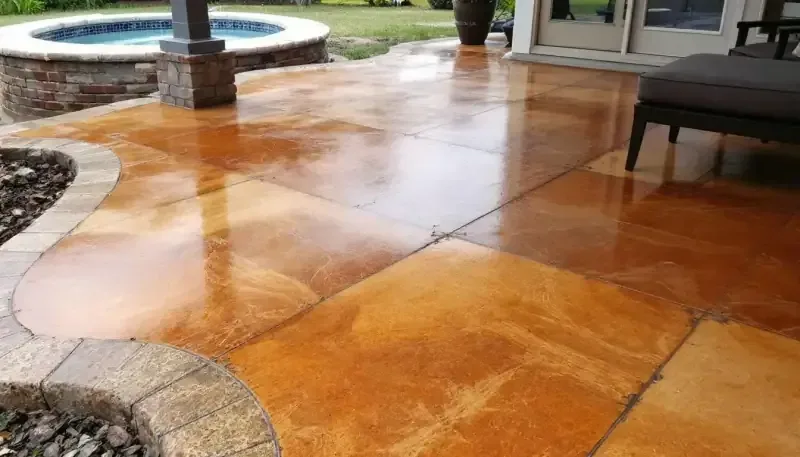
Stained & Colored Concrete in Harrisonville, MO
Your Harrisonville home deserves concrete that actually looks like you chose it on purpose — not something the builder poured and forgot about.
What Does Stained Concrete Actually Cost in Harrisonville?
Let's talk numbers first. Basic concrete staining in Harrisonville runs between $3 and $8 per square foot for existing slabs. New colored concrete pours land between $8 and $15 per square foot depending on complexity. Those ranges reflect real Cass County pricing — local labor rates, material delivery from KC-area suppliers, and the prep work your specific slab demands.
Why the range? Your slab's age and condition drive the final number more than anything. A clean, well-maintained patio in Creekstone Estates might need minimal surface prep before staining. A 30-year-old walkway near the Original Town neighborhood with decades of wear, efflorescence, and old sealer buildup will cost more because the prep takes longer. Prep is where the money goes.
Material costs in southern Cass County stay pretty stable. We source stains and sealers from regional concrete supply houses, so we avoid the markup that comes with specialty shipping. Acid stains run cheaper per application but require neutralization steps. Water-based stains cost slightly more upfront but give us broader color control. Both deliver lasting results on Harrisonville concrete.
The honest truth: stained concrete is one of the most cost-effective ways to transform your property. Compared to tearing out and replacing a patio or driveway, staining your existing slab saves you 40 to 60 percent. That math works especially well for homeowners along the MO-7 corridor or in Southview who want a fresh look without a full demolition project.
How Stained & Colored Concrete Transforms Harrisonville Properties
Stained concrete turns ordinary gray slabs into surfaces with depth, warmth, and character. In a town anchored by the historic Cass County Courthouse and its iconic Square, aesthetics matter. Homeowners in Harrisonville increasingly choose staining over replacement because the results look custom without the custom price tag. Earth tones, terracottas, and slate-inspired hues are especially popular here — colors that complement both newer builds in The Vineyards and older homes closer to downtown.
Colored concrete works differently from staining. With integral color, pigment gets mixed directly into fresh concrete during a new pour. This means the color runs through the entire slab, not just the surface. It's ideal for new driveways, patios, and sidewalks. If you're building in one of Harrisonville's growing subdivisions or adding square footage to your property, integral color gives you a finished look from day one.
Both approaches — staining existing concrete and pouring new colored concrete — hold up well in this part of Missouri. Proper sealing protects against UV degradation, moisture intrusion, and the wear that comes from daily use. We've completed 377 projects across the KC metro since 2015, and our Cass County work consistently proves that well-applied stain or color lasts years with basic upkeep.
Harrisonville-Specific Stained & Colored Concrete Considerations
Cass County Clay Soil and Slab Movement
Harrisonville sits on expansive clay soil that swells when wet and contracts during dry spells. This movement can cause hairline cracks in concrete slabs over time. Before staining, we assess every slab for active cracking and settlement. Minor cracks get filled with color-matched repair material. If your slab in North Woods or along Commercial St shows significant shifting, we'll tell you upfront whether staining makes sense or if a new pour with integral color is the smarter investment.
UV Exposure on South-Facing Patios
Missouri summers deliver intense UV light, and south-facing patios in Harrisonville catch the worst of it. Color longevity depends heavily on sealer quality and reapplication frequency. We use UV-resistant sealers that slow fading significantly. Darker stain colors show UV wear faster than mid-tones, so we guide homeowners toward shades that age gracefully. A south-facing patio in Southview needs different color planning than a shaded slab under a mature tree canopy.
Existing Sealer and Coating Removal
Many Harrisonville homes built in the late 1990s and early 2000s have patios or garage floors coated with acrylic sealers or epoxy. Stain cannot penetrate those coatings. Removal adds time and cost. We use diamond grinding and chemical stripping to get down to bare concrete before any stain application. If your home near Harrisonville City Park has a previously sealed patio, expect an additional prep phase — but it's essential for a stain that bonds properly and lasts.
Timing Around the I-49 Construction Corridor
The I-49 and Commercial St interchange project running through 2025-2026 means dust, vibration, and altered traffic patterns for nearby homes. If your property sits close to this corridor, timing your staining project matters. We schedule exterior staining work during low-dust windows and apply stain early in the day before construction traffic kicks up particulates. Airborne debris settling on wet stain or sealer creates texture defects, so scheduling precision is critical in this part of town right now.
How We Build Stained & Colored Concrete in Harrisonville
Every staining project starts with a slab evaluation. We walk your concrete with a moisture meter and a trained eye. In Cass County, clay soil moisture can wick upward through older slabs that lack proper vapor barriers. High moisture readings change our approach — we may need to apply a moisture-mitigating primer before staining. We also test for previous sealers using a water droplet test. If water beads on the surface, something's blocking penetration and it has to come off first.
Surface preparation is where this work gets real. Our crew uses walk-behind diamond grinders for large areas like patios and driveways, and hand-held grinders for edges, steps, and tight spots near foundation walls. Grinding opens the concrete pores so stain absorbs evenly. On slabs with oil stains — common in Harrisonville garages — we apply a degreasing agent and sometimes a poultice to draw contamination out of the pores. We don't cut corners here because every shortcut shows up in the final color.
Stain application is methodical. For acid stains, we use pump sprayers and brushes to build up color in thin, overlapping passes. Acid stain reacts chemically with the lime content in concrete, so no two slabs look identical — that's part of the appeal. We neutralize the acid with a baking soda solution, rinse thoroughly, and let the slab dry completely. For water-based stains, we apply with HVLP sprayers for even coverage and can layer multiple colors to create depth. Harrisonville homeowners tend to favor warm ambers and walnut tones that echo the sandstone tones on buildings around the Historic Square.
Sealing is the final step and arguably the most important. We apply two coats of high-solids acrylic or polyurethane sealer depending on the application. Exterior patios and driveways get a slip-resistant additive worked into the topcoat. We source our sealers from suppliers in the KC metro to keep lead times short and ensure product freshness. After sealing, the surface needs 24 to 48 hours of cure time before foot traffic and 72 hours before vehicles. We mark everything clearly and leave written care instructions specific to your project.
From Faded Gray to Warm Amber: A Creekstone Estates Patio Transformation
A homeowner in Creekstone Estates reached out about a 450-square-foot backyard patio that had been poured during the home's original construction around 2008. The concrete was structurally sound but cosmetically forgettable — plain gray with minor surface crazing and a few hairline cracks near the south edge where clay soil movement had stressed the slab. The homeowner wanted something that matched the warm stone accents on the house without the expense of tearing out and replacing the patio.
Our crew spent the first day on prep. We filled the hairline cracks with a polymer-modified repair compound, then diamond-ground the entire surface to remove light efflorescence and open the pores. The next morning we applied a two-tone acid stain — cola as the base layer with a desert amber wash layered over the top. The chemical reaction with the slab's lime content produced a rich, mottled finish with natural variation that looked like weathered flagstone from a distance.
After neutralizing and rinsing, we sealed the patio with two coats of a UV-resistant acrylic sealer mixed with a fine anti-slip aggregate. The homeowner had the patio back in full use within four days. The total cost came in under $2,800 — roughly a third of what a full tear-out and repour would have run. That patio now anchors their backyard and draws compliments from neighbors walking the Creekstone loop.
How Much Does Stained & Colored Concrete Cost in Harrisonville?
| Type | Cost / Sq Ft | Typical 300 Sq Ft |
|---|---|---|
| Acid Stain (Existing Concrete) | $4–8 | $1,200–$2,400 |
| Water-Based Stain (Existing) | $3–6 | $900–$1,800 |
| Integral Color (New Pour) | $10–15 | $3,000–$4,500 |
Harrisonville pricing reflects moderate Cass County labor rates and shorter drive times from our KC-area supply chain compared to more rural counties further south. Expect $3–$8 per square foot for staining existing slabs and $8–$15 for new colored pours, with slab condition and prep complexity being the biggest cost variables.
Stained & Colored Concrete FAQ for Harrisonville, MO
Can stained concrete handle the deicing salt my neighbor spreads near our shared driveway along MO-291?
Deicing salt is tough on any concrete surface, but properly sealed stained concrete resists salt damage well. The sealer acts as a barrier between the salt solution and the stain layer. We recommend a fresh sealer coat every two to three years for driveways near high-salt-use areas like MO-291 frontage. If salt exposure is heavy, we apply a penetrating sealer underneath the topcoat for double protection. Rinse salt residue off with a garden hose once temperatures climb above freezing in spring. That simple step extends your sealer's life significantly.
What stain colors work with Harrisonville's newer subdivision homes?
Homes in Creekstone Estates and The Vineyards tend to feature neutral siding — grays, tans, and muted blues. Warm-toned stains like cola, desert amber, and English red complement those palettes without competing. For homes with stone veneer accents, we often recommend a stain that picks up one of the secondary tones in the stone. We bring physical stain samples to your property and test them on an inconspicuous corner of your slab. Seeing the color react with your specific concrete mix in natural light beats any color chart.
How does staining hold up on a covered front porch versus an exposed backyard patio?
Covered surfaces last longer between resealing because they avoid direct UV and rain exposure. A covered porch might go three to four years between sealer applications. An exposed patio in full Harrisonville sun typically needs resealing every 18 to 24 months. The stain itself is permanent — it's the sealer that wears. We factor your porch or patio's exposure into our sealer recommendation. Covered areas can use a thinner, more aesthetically refined sealer. Exposed areas get a heavier-duty product with UV inhibitors.
I want to stain my garage floor. Do you handle the oil cleanup?
Yes. Garage floors are some of our most common projects. Oil contamination requires targeted degreasing before staining. We apply commercial-grade degreasers and sometimes use an absorbent poultice that sits overnight to pull deep oil deposits from the concrete pores. After cleaning, we grind the surface to open fresh concrete. Heavily stained areas may show slight color variation after staining — acid stain reacts differently where oil has altered the concrete chemistry. We discuss this upfront so you know exactly what to expect. Most Harrisonville garage floors clean up well enough for a great result.
Can you pour a new colored concrete patio and add a stained border for contrast?
Absolutely. Combining integral color with a stained border or accent band is one of the most striking options available. We pour the slab with integral color mixed throughout, then come back after curing to apply a contrasting stain to designated border areas. Saw-cut lines define the border zones cleanly. This technique works beautifully on larger patios where a single uniform color can feel flat. We've done this on several Cass County properties and the dimensional effect always impresses.
Do you stain concrete steps and stoops, or just flat surfaces?
We stain steps, stoops, landing pads, and any concrete surface with adequate structural integrity. Steps require careful masking and application to keep color transitions clean between treads and risers. Older stoops near Original Town and downtown Harrisonville sometimes have worn edges or minor spalling that needs patching first. We use color-matched repair compounds so patches blend with the final stain. Vertical risers get hand-applied stain rather than spray to prevent dripping and ensure even coverage. The result is a cohesive look from your walkway up through your front entrance.
Other Concrete Services in Harrisonville, MO
Request a Callback About Your Harrisonville Project
Leave your number and a few details about your slab. We return calls within one business day and serve all of Harrisonville from Creekstone Estates to the Historic Square and everywhere between.