
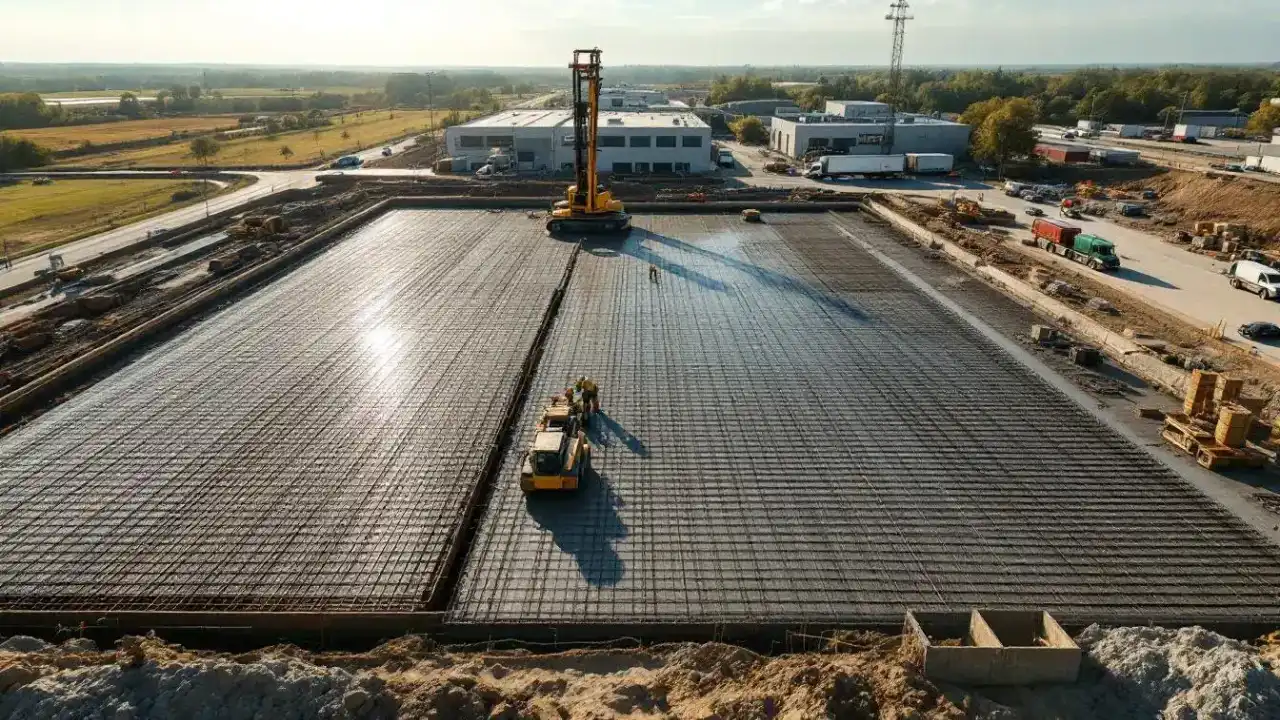
Mat Foundation Contractors in Kansas City
Full-coverage raft foundations distributing building loads across the entire footprint — engineered for KC’s challenging clay, alluvial soils, and heavy industrial loads.
When Does a Building Need a Mat Foundation Instead of Individual Footings?
A mat foundation — also called a raft slab — becomes the right choice when the structural engineer reaches a crossover point where individual spread footings no longer make practical or economic sense. That crossover happens when column loads are heavy enough that individual footings would need to be 8 feet square or larger, or when adjacent footings would overlap each other at the required bearing dimensions. Instead of pouring dozens of oversized individual pads, a single continuous slab covers the entire building footprint and distributes the total structural load across the maximum possible area. The bearing pressure on the soil drops to the average building weight per square foot — often 60 to 80 percent lower than what individual footings would impose at their edges.
In the Kansas City metro, three soil conditions push projects toward mat foundations more often than in other markets. First, alluvial deposits along the Missouri and Kansas river corridors carry inconsistent bearing capacity — sand and silt layers that may support 2,500 psf in one boring and 1,200 psf in the next boring 40 feet away. Individual footings on these sites settle at different rates, creating the differential movement that cracks structural frames and damages finishes. A mat foundation rides over these variations, averaging the bearing across the entire footprint and controlling differential settlement through the rigidity of the slab itself.
Second, old uncontrolled fill sites in the East Bottoms, West Bottoms, and Fairfax industrial districts present fill material of unknown origin placed decades ago without compaction documentation. Building on uncontrolled fill with individual footings is a recipe for failure — each footing finds a different density and composition beneath it. A mat foundation, combined with deep over-excavation and structural fill replacement, provides uniform support across the footprint. Third, heavily loaded industrial buildings — distribution centers with high-density racking, manufacturing facilities with concentrated equipment loads — generate column loads that push spread footings beyond practical dimensions on KC’s moderate-bearing clay soils. The mat is not just the safer choice; it is frequently the more economical one when the alternative is 30 or 40 oversized individual footings with extensive over-excavation at each location.
Why Are Mat Foundations Common on KC River Valley and Fill Sites?
The Missouri and Kansas river corridors that define the KC metro create some of the most variable soil conditions in the Midwest. Alluvial sand and silt deposits shift in bearing capacity across short distances — a boring at one corner of the building may show 2,500 psf while the opposite corner reads 1,200 psf. Individual spread footings on this soil settle at different rates. One column drops a quarter inch while its neighbor drops three-quarters. That half-inch differential propagates upward through the steel frame, cracking finishes, binding doors, and racking equipment.
Old industrial fill sites compound the problem. Decades of uncontrolled fill placement without compaction documentation means the material beneath the building is unknown in composition, density, and depth. A mat foundation — combined with deep over-excavation and engineered structural fill — eliminates the uncertainty. The rigid slab bridges over minor soil inconsistencies, and the uniform subgrade preparation ensures the bearing surface beneath the mat is consistent from edge to edge.
Planning a Heavy Industrial or Warehouse Foundation?
Talk to our mat slab specialists. Send your structural drawings and geotech report for a detailed bid.
What Engineering Goes Into a Kansas City Mat Foundation?
Mat foundation design is driven by three structural calculations that determine the slab thickness, reinforcement, and concrete specification. Punching shear at column locations is the primary failure mode — the column load tries to punch through the mat like a finger through drywall. The structural engineer calculates the shear stress around each column perimeter and sizes the mat thickness to keep that stress below the concrete's shear capacity, or adds headed shear studs to reinforce the critical perimeter. On heavily loaded columns — 200,000 to 500,000 pounds in a warehouse or industrial building — punching shear often governs the mat thickness at 36 to 48 inches.
Bending moments between columns create the second design requirement. Upward soil pressure between columns bends the mat upward (positive moment), while the concentrated column loads bend it downward at the column locations (negative moment). Two-way reinforcing steel — top and bottom mats of number 6 to number 9 bars at 6 to 12 inch spacing in both directions — resists these opposing bending forces. The bottom mat handles the positive moment; the top mat handles the negative moment. Additional reinforcing at column locations supplements the punching shear resistance.
Thermal cracking prevention is the third critical engineering concern on any mat over 30 inches thick. Cement hydration generates heat — in a 36-inch mat, the core temperature can exceed 150 degrees Fahrenheit while the surface cools toward ambient. If the differential exceeds 35 degrees Fahrenheit, thermal cracks propagate from the surface inward. The pour plan must address thermal control: low-heat mix designs with fly ash or slag cement replacement to reduce peak temperature, placement during cooler hours in KC summers, insulated blankets to control cooling rate, and embedded thermocouples for real-time temperature monitoring throughout the 5 to 7 day curing period. Kansas City Concrete Contractors includes a thermal management plan as a standard deliverable on every mat foundation project.
Mass pour logistics complete the engineering challenge. A 10,000 square foot mat at 30 inches thick requires approximately 400 cubic yards of concrete — 40 to 50 ready-mix trucks placed in a single continuous operation. The pour cannot stop. A cold joint in a mat foundation compromises the structural integrity of the entire slab. We coordinate the ready-mix supply chain, boom pump positioning, crew staging, and backup equipment before concrete day, building redundancy into every element of the operation.
- Typical Thickness
- Range: 24–48 inches
- Concrete Strength
- Specification: 5,000–6,000 PSI
- Rebar Configuration
- Layout: #6–#9 bars, 6–12″ O.C., both ways, top & bottom
- Pour Rate
- Delivery: 1 truck every 8–12 minutes
- Thermal Control
- Max differential: 35°F core-to-surface
Warehouse & Industrial
Heavy racking loads, forklift traffic, and concentrated column loads push individual footings beyond practical dimensions. Mat foundations distribute these loads across the full footprint while providing the flat, level surface that high-bay racking systems demand.
Multi-Story Structures
Three to five story buildings with closely spaced columns generate cumulative loads that would require overlapping footings on KC clay. A mat foundation handles the combined loading while controlling the differential settlement that damages upper-floor finishes and mechanical systems.
River Valley Sites
Alluvial sand and silt along the Missouri and Kansas rivers carry variable bearing capacity across short distances. Mat foundations average the bearing across the full footprint, controlling differential settlement that individual footings on these soils cannot prevent.
How Is a Mat Foundation Poured From Start to Finish?
Six phases from geotechnical analysis through final cure. Every phase verified before advancing to the next.
Geotech Analysis & Mat Design
Review geotechnical boring logs, soil classification, and allowable bearing pressures.
Coordinate with the structural engineer on mat thickness, reinforcement schedule, and punching shear design at column locations. Identify KC-specific risks: alluvial variability near river corridors, old uncontrolled fill requiring removal, and Wymore clay moisture sensitivity that affects subgrade preparation.
Mass Excavation & Soil Prep
Excavate to design subgrade elevation across the full building footprint.
Over-excavate unsuitable native soil — typically 24 to 48 inches on alluvial and fill sites — and replace with compacted structural fill. Every lift placed in 8-inch layers, moisture-conditioned, and compacted to 95 percent modified proctor with nuclear density gauge verification at depth. The subgrade beneath a mat foundation must be uniform across the entire footprint — any soft pocket creates a stress concentration in the slab above.
Two-Way Rebar Placement
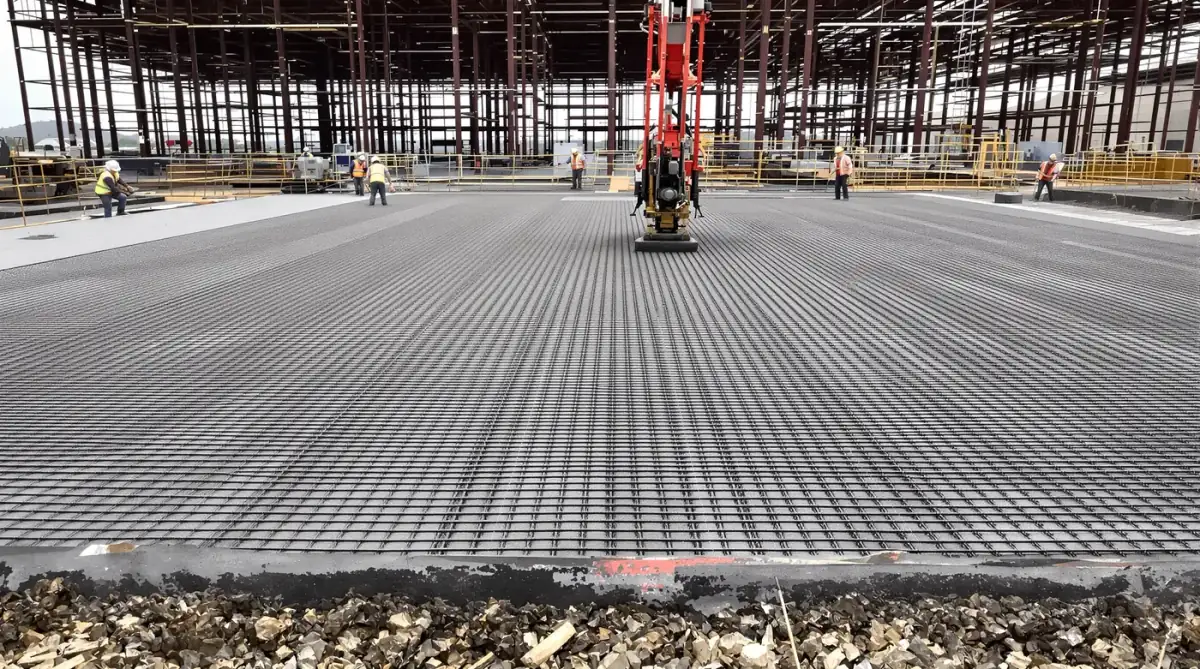
Install bottom mat reinforcement first — typically number 6 to number 9 bars at 6 to 12 inch spacing in both directions, supported on heavy-duty bar chairs rated for the concrete head pressure of a 24 to 48 inch slab.
Place top mat reinforcement on supports maintaining the design clear spacing between layers. Add punching shear reinforcement at column locations — headed studs or additional bars per the structural design. A 10,000 square foot mat may require 40 to 60 tons of reinforcing steel placed over 3 to 5 days.
Pour Logistics & Staging
Coordinate the ready-mix supply chain before concrete day.
A 400 cubic yard mat requires 40 to 50 truck loads on a staggered 8 to 12 minute delivery schedule to maintain continuous supply at the pump. Position boom pump for maximum reach coverage. Stage two finishing crews, internal vibrators, and backup equipment. Verify concrete mix design — 5,000 to 6,000 psi with controlled heat of hydration for mass placement. Hot weather pours use ice or chilled water; cold weather pours use heated water and accelerator.
Continuous Placement & Finishing
Place concrete in systematic strips advancing across the footprint, maintaining a live edge on previously placed concrete to eliminate cold joints.
Internal vibrators consolidate every lift to remove voids and honeycombing around the dense rebar grid. Finishing crews follow the placement crew, striking off and bull-floating each section while the concrete is still workable. On a 400 cubic yard mat, the pour may run 8 to 12 hours with no stops. This is the operation where experience matters most — timing, crew coordination, and concrete supply chain management determine whether the mat is poured as one monolithic slab or compromised by cold joints.
Thermal Monitoring & Curing
On mats over 30 inches thick, install embedded thermocouples at the core and surface before the pour.
Monitor the temperature differential between core and surface continuously for 5 to 7 days — keeping the differential below 35 degrees Fahrenheit to prevent thermal cracking. Apply insulated blankets immediately after finishing: in winter to slow surface cooling, in summer removed gradually over 3 to 5 days to prevent thermal shock. Wet cure critical areas for 7 days. Pull break test cylinders at 7 and 28 days to verify specified compressive strength.
How Do You Prevent Thermal Cracking in a Thick Mat Foundation?
Cement hydration is exothermic — the chemical reaction that hardens concrete generates heat. In a 4-inch sidewalk, that heat dissipates harmlessly. In a 36-inch mat foundation, the interior temperature can exceed 150 degrees Fahrenheit while the surface cools toward ambient temperature. The trapped heat creates a temperature gradient between the core and the surface. When that differential exceeds 35 degrees Fahrenheit, the surface contracts while the interior remains expanded, generating tensile stresses that crack the concrete from the outside in.
Thermal cracking prevention starts with the mix design. Replacing 25 to 40 percent of Portland cement with fly ash or slag cement reduces the peak hydration temperature by 15 to 25 percent without sacrificing the 28-day compressive strength the structural engineer specified. Placement timing matters — pouring during cooler evening hours in KC summers limits the initial concrete temperature to 85 degrees or less.
After placement, insulated blankets are the primary tool. In winter, they slow surface cooling to keep the differential below 35 degrees. In summer, they are removed gradually over 3 to 5 days to prevent thermal shock from a sudden temperature drop at the surface. Embedded thermocouples at the core and surface provide real-time temperature data throughout the curing period — typically 5 to 7 days on mats over 30 inches thick. Our crew monitors the readings and adjusts blanket coverage as needed to maintain the gradient within safe limits.
Mat Foundation Cost Ranges in Kansas City
| Component | Typical Range | Notes |
|---|---|---|
| Mat foundation (complete, in place) | $12 – $25 / SF | Thickness and rebar density dependent |
| Over-excavation & structural fill | $15 – $30 / CY | Depth and haul distance dependent |
| Reinforcing steel (placed and tied) | $1.20 – $1.80 / lb | 40-60 tons typical on 10,000 SF mat |
| Concrete (5,000+ psi, pumped) | $180 – $240 / CY | Includes pump and placement |
| Thermal monitoring (mass pour) | $2,000 – $5,000 | Thermocouple install and monitoring |
Mat foundation pricing varies significantly based on slab thickness, reinforcement density, soil conditions, and pour volume. A 10,000 square foot mat at 30 inches thick typically runs $120,000 to $250,000 in the Kansas City metro. The higher end of the range applies to heavily reinforced mats on sites requiring deep over-excavation and structural fill. Call (816) 339-8133 with your structural drawings and geotech report for a detailed, line-item bid.
Questions About Mat & Raft Slab Foundations in Kansas City
When is a mat foundation the right choice in Kansas City?
How thick is a typical commercial mat foundation?
How is a mat foundation reinforced?
How do you pour a mat foundation without cold joints?
What does a mat foundation cost in Kansas City?
How do you prevent thermal cracking in thick mat foundations?
Mat Foundation Construction Across the Kansas City Metro
Other Foundation Types & Commercial Concrete Services
Spread Footings
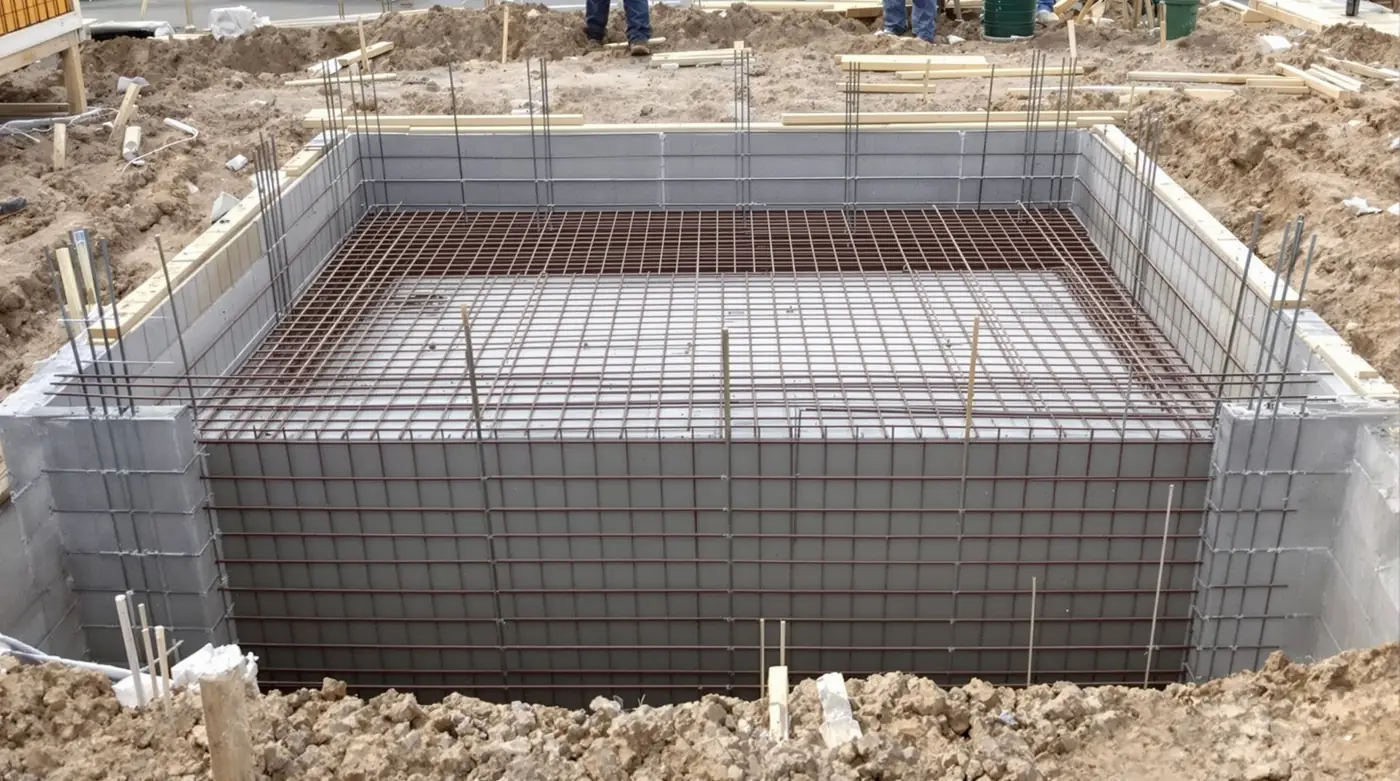
Individual reinforced concrete pads distributing column loads on KC clay.
Continuous Footings
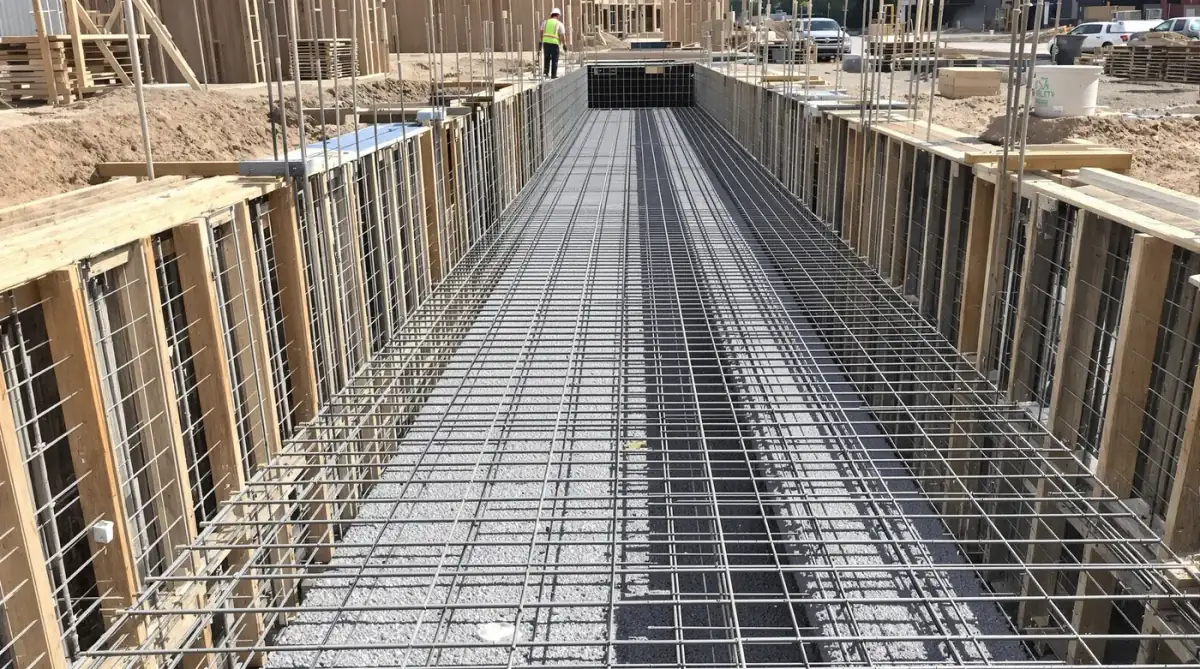
Strip footings beneath bearing walls and building perimeters.
Grade Beams
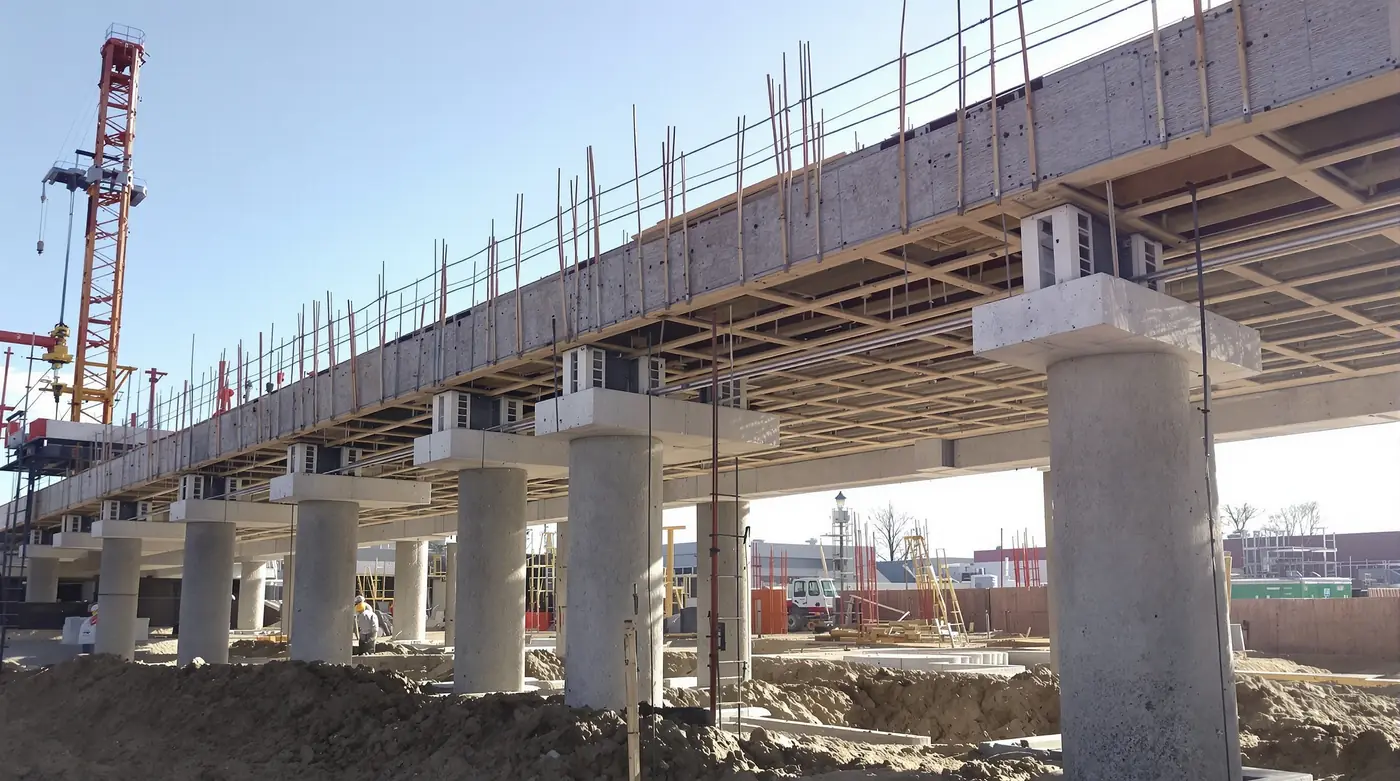
Reinforced beams spanning between drilled piers to competent bearing.
Equipment Pads
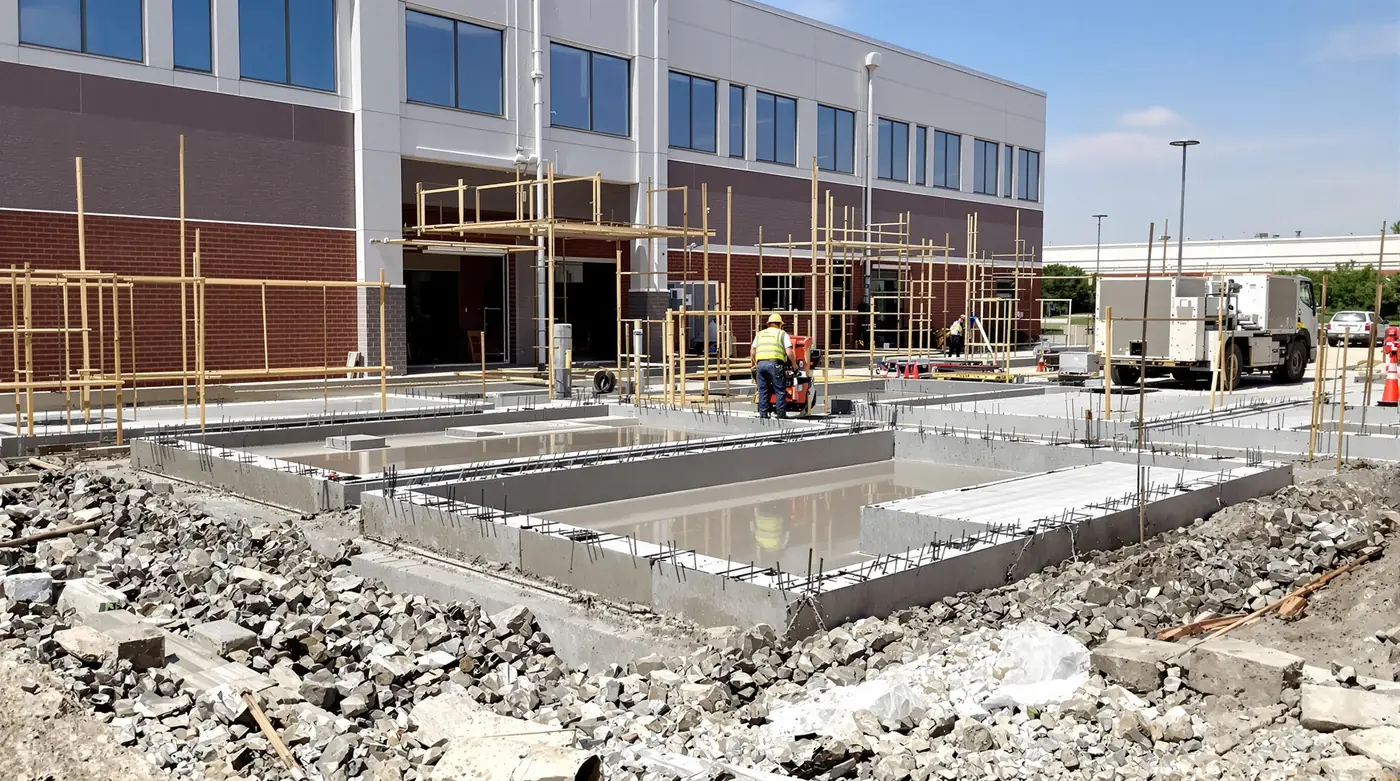
HVAC, generator, and manufacturing equipment foundations.
Commercial Foundations Hub
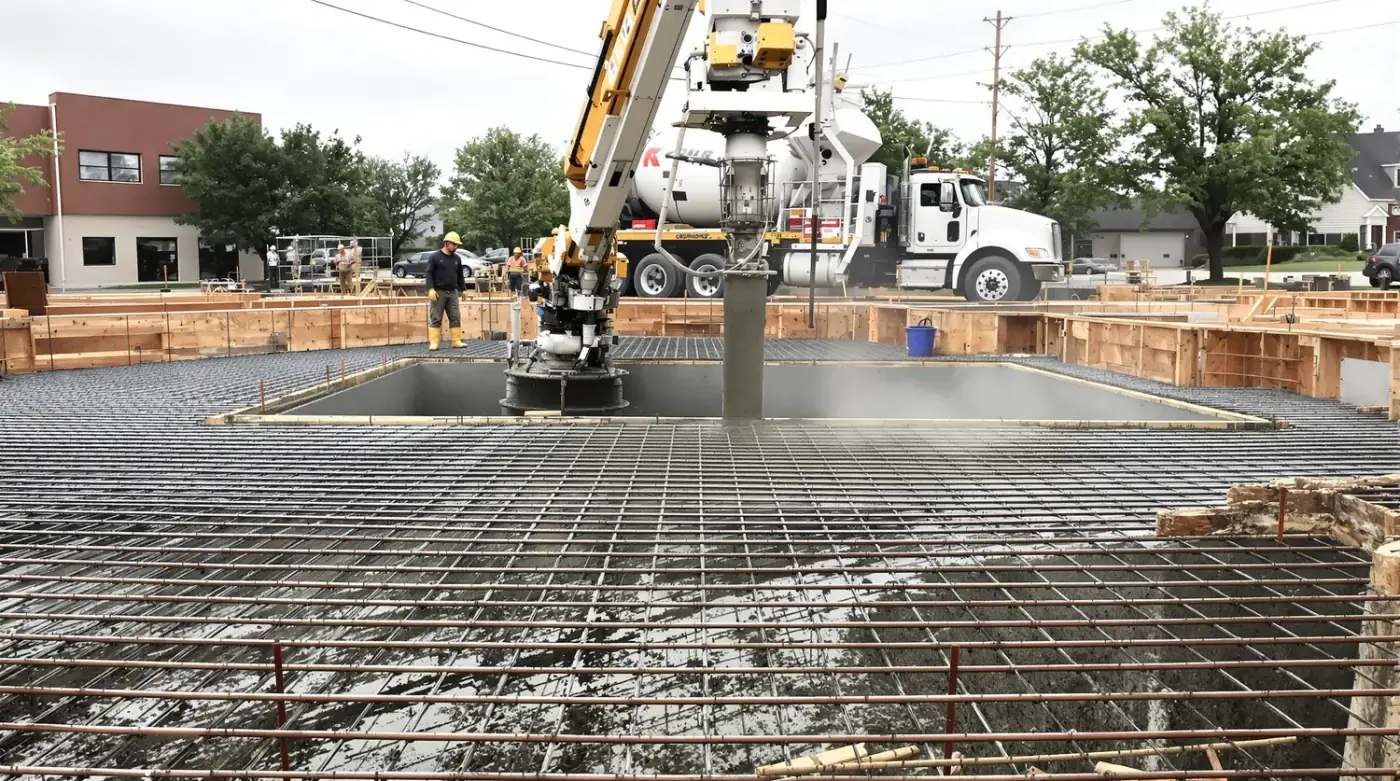
All foundation types for KC commercial and industrial construction.
Get a Bid on Your Mat Foundation Project
Send us the structural drawings, the geotechnical report, and the project timeline. We return a detailed line-item bid within 5 business days that separates excavation, structural fill, compaction testing, rebar, concrete, thermal monitoring, and curing — so your team can compare scope-for-scope against other subcontractors. If you are early in the design phase and do not yet have structural drawings, we can provide a budgetary estimate based on the building footprint, loading, and geotech report.
- ✓400+ cubic yard single continuous pours
- ✓Thermal management plan on every mass pour
- ✓Sitework + concrete under one contract
- ✓Licensed in Missouri and Kansas
Start Your Mat Foundation Bid
Click below to open the bid request form. Provide the project address, building type, approximate square footage, and any drawings or geotech reports you have available. We respond within one business day to confirm receipt and request any additional information needed for a complete bid.