
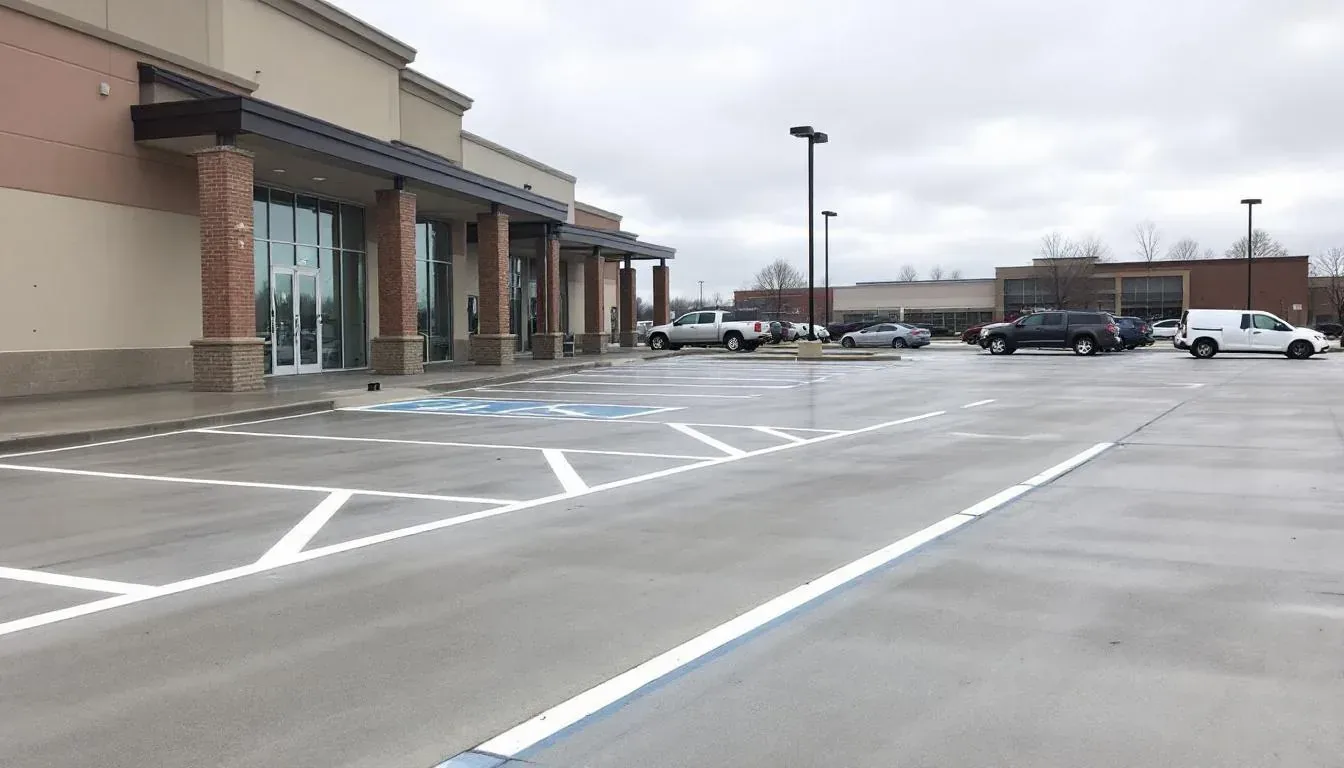
Parking Lots in Blue Springs, MO
Blue Springs businesses along MO-7 and Adams Dairy Parkway are sitting on parking lots that were poured before most of their employees were born. We replace them with concrete built for the next 30 years.
When Did You Last Walk Your Lot at Adams Dairy Landing?
Drive through Adams Dairy Landing on any Saturday morning and the lots are packed. Families heading to shop, commuters grabbing coffee before the I-70 merge, employees parking for eight-hour shifts. That kind of daily traffic punishes old asphalt. The graying, the crumbling edges, the potholes that swallow a coffee cup — they tell your customers something about your business before they ever walk through the door.
Blue Springs grew fast in the 1970s and 80s. The commercial boom along Old 40 and MO-7 gave this city its retail backbone. But those original parking lots? They've exceeded their 30-to-40-year structural lifecycle. Patch jobs and sealcoats can only mask so much. Eventually the subbase fails, water infiltrates, and you're looking at a full rehabilitation. That moment has arrived for dozens of lots across the 7 Highway Retail Corridor and White Oak Plaza.
We've completed 377 projects since 2015, and a growing number are right here in Blue Springs. Business owners are making the switch from deteriorating asphalt to reinforced concrete — a surface that handles the dense MO-7 traffic, resists freeze-thaw cycles, and doesn't need resurfacing every five years. If your lot has become a liability instead of an asset, it's time to talk.
What a Full Concrete Parking Lot Replacement Looks Like in Blue Springs
A concrete parking lot isn't a thin skin over dirt. We engineer the full section — typically 6 to 8 inches of reinforced concrete over a compacted aggregate base, with proper joint spacing to control cracking in Jackson County's freeze-thaw climate. For heavier-use lots near the North 7 Highway Industrial zone, we design thicker sections and closer rebar spacing to handle truck traffic and delivery vehicles without surface failure.
Drainage is the number-one hidden problem in Blue Springs commercial lots, especially in the older strips near the downtown core. Original storm drainage systems are undersized or collapsed. We address this during demolition by regrading slopes and installing updated catch basins and pipe connections. Your new lot sheds water toward planned collection points instead of pooling against your building foundation or flooding neighboring properties.
Every lot we pour includes ADA-compliant accessibility features — van-accessible spaces, detectable warning surfaces, proper slopes, and signage placement. We handle the striping and wheel stops as part of the project. When our crew leaves, your lot is ready for traffic. No loose ends, no callbacks for missing details.
Blue Springs-Specific Parking Lots Considerations
Aging Subbase Conditions Along Old 40 and MO-7
Most commercial lots in these corridors were built on native clay subgrade with minimal base rock. Forty years of water infiltration has softened that subgrade. We don't pour over compromised soil. Our crew excavates the full section, proof-rolls the subgrade with loaded equipment, and addresses soft spots with engineered fill before placing the aggregate base. Skipping this step is why cheap overlays fail within three years. We've seen it on project after project across the 7 Highway Retail Corridor.
High-Volume Traffic Patterns on Adams Dairy Parkway
Adams Dairy Parkway feeds thousands of vehicles daily into the commercial zone around Adams Dairy Landing. That kind of turning, braking, and acceleration polishes asphalt smooth and punches through weak spots fast. Concrete resists surface polishing far better than asphalt. We also design entrance aprons with thicker sections — typically 8 inches — where turning movements concentrate stress. The goal is zero maintenance for your first decade.
Jackson County Stormwater and Grading Requirements
Jackson County enforces stormwater management standards for any lot replacement that changes grading or impervious surface area. If your project triggers these thresholds, you'll need an approved stormwater plan before work begins. We coordinate with local engineering firms and handle the county permitting process so you're not chasing paperwork. Many Blue Springs business owners are surprised to learn their old lot was never properly permitted — we bring everything into compliance during the rebuild.
What to Expect During Your Blue Springs Parking Lot Project
Before anything gets torn up, we walk your lot together and map out a phased plan. Most Blue Springs businesses can't shut down entirely, so we divide the lot into sections and keep a portion open throughout construction. You'll get a written schedule showing which areas close on which days. We coordinate with your busiest hours — if Saturday mornings are your peak at Adams Dairy Landing, we plan around that.
Demolition day is loud. A hydraulic breaker or sawcutter opens up the old surface, and a loader stacks material for haul-off. Our trucks stage on your lot or in a designated area along the frontage — we keep equipment off adjacent roadways. Expect dust control measures and flagging for pedestrian safety. If your lot borders MO-7 or Adams Dairy Parkway, we may need a Jackson County right-of-way permit for curb tie-ins, and we handle that filing in advance.
Once the old surface is removed, we grade the subbase, compact in lifts, and place forms. The concrete pour itself is fast — a full section can go down in a single day depending on lot size. Concrete trucks stage in the completed or unopened portion of the lot and pump material into forms. You'll hear the vibrators consolidating the mix and see our finishers working the surface smooth. Curing compound goes on immediately.
After the concrete cures — typically seven days for light traffic, 28 days for full strength — we cut control joints, stripe the lot, install wheel stops, and complete any signage. Jackson County may require a final inspection before you open the full lot. We schedule that inspection and walk it with the inspector. Your first day back at full capacity, the lot looks and performs like a completely different property.
Asphalt Overlay vs. Full Concrete Replacement: The Real Math for Blue Springs Lot Owners
An asphalt overlay on a failing lot costs around $2.50 to $4.00 per square foot in the Blue Springs market. That sounds attractive compared to $6.50 to $9.50 for concrete. But here's the problem — an overlay on a failed subbase is a five-year fix at best. You'll reseal it every two years and patch it annually. Over 20 years, you'll spend $12 to $15 per square foot maintaining that asphalt surface. Concrete over the same period costs you the initial pour plus joint sealing every seven to ten years. Total 20-year cost runs closer to $8 to $11 per square foot.
Performance matters too. Adams Dairy Parkway and MO-7 generate heavy turning traffic that polishes asphalt smooth and creates ruts at stop points. Concrete resists these forces. It doesn't soften in August heat or rut under heavy braking. For Blue Springs businesses dealing with high customer turnover — restaurants, retail, medical offices — concrete maintains its surface integrity and appearance far longer than asphalt.
There's also the appearance factor. Asphalt starts graying within two years without sealcoat. Drive along the 7 Highway Retail Corridor and you can spot deferred-maintenance lots from a block away. A concrete lot stays clean and bright with minimal upkeep. In a competitive retail environment where first impressions drive foot traffic, that visual difference translates directly to revenue.
How Much Does Parking Lots Cost in Blue Springs?
| Type | Cost / Sq Ft | Project Dependent |
|---|---|---|
| Standard Concrete Lot | $4–8 | Varies by scope |
| Heavy-Duty (Truck Traffic) | $6–10 | Varies by scope |
| Repair / Section Replace | $8–14 | Varies by scope |
Concrete parking lots in Blue Springs typically run $6.50 to $9.50 per square foot depending on subgrade conditions and thickness requirements. Lots along the older MO-7 corridor often run higher due to extensive subbase remediation and outdated drainage infrastructure that needs replacement.
Parking Lots FAQ for Blue Springs, MO
How do you phase a parking lot project so my Blue Springs store stays open?
We divide your lot into sections — usually halves or thirds — and pour one section at a time. Each phase gets its own curing window before we move to the next. Temporary signage and barriers direct your customers to the open portion. For high-traffic locations near Adams Dairy Landing or White Oak Plaza, we shift work to evening or overnight hours when possible. Most businesses report losing less than 15 percent of normal parking capacity on any given day during construction.
What causes the severe potholing on older Blue Springs commercial lots?
Two factors dominate. First, the original asphalt lots from the 1970s and 80s were built on native clay with thin base rock. Water penetrates cracked asphalt, saturates the clay, and the subgrade loses bearing capacity. Second, Blue Springs gets over 40 inches of rain annually and significant freeze-thaw cycles. Each freeze event expands trapped moisture and breaks the pavement from below. Once the subbase fails, patching is temporary. The only lasting fix is full-depth removal and a properly engineered concrete replacement.
Will my insurance rates change with a new concrete lot?
Some commercial property insurers do factor lot condition into liability assessments. A lot full of potholes, cracked surfaces, and faded striping represents a trip-and-fall risk. While we can't guarantee a rate reduction, we've had Blue Springs clients report that their insurer acknowledged the improvement during renewal. At minimum, a well-maintained concrete lot with proper ADA compliance reduces your exposure to premises liability claims.
How deep do you excavate for a commercial lot near the North 7 Highway Industrial area?
Industrial lots see heavier loads — delivery trucks, forklifts, loaded trailers. We excavate 12 to 16 inches below finished grade. That gives us room for 6 inches of compacted aggregate base and 7 to 8 inches of reinforced concrete. In areas with confirmed soft clay, we go deeper and add geotextile fabric to separate the subgrade from the base rock. Every industrial lot gets a unique section design based on what we find during excavation.
Do you handle fire lane markings and compliance for Blue Springs commercial properties?
Yes. Fire lane marking is part of our standard scope for commercial lots. Blue Springs follows the International Fire Code, and the fire marshal's office reviews fire lane placement, width, and marking before issuing approval. We coordinate the layout with local requirements — red curb painting, signage placement, and minimum 20-foot lane widths. If your existing lot has fire lane violations from prior non-compliant work, we correct them during the rebuild so you pass inspection the first time.
Other Concrete Services in Blue Springs, MO
Schedule Your Free On-Site Parking Lot Consultation
We'll walk your lot, identify subgrade failures and drainage issues, measure the full scope, and give you a detailed written proposal — typically within 48 hours of our Blue Springs site visit.