
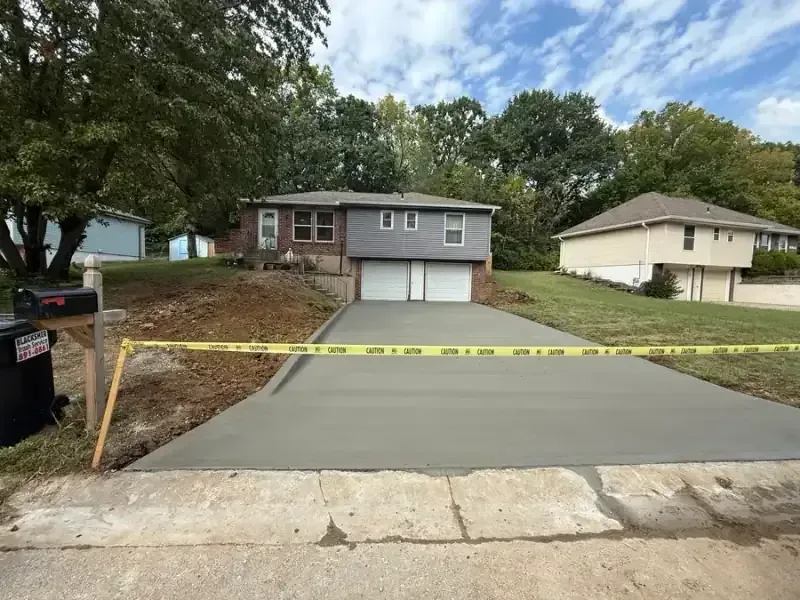
Concrete Driveways in Blue Springs, MO
Blue Springs homeowners deal with everything from freeze-thaw cracking to heavy commuter traffic wearing down their slabs. We build driveways engineered for the way this city actually lives.
Is your Blue Springs driveway showing its age this summer?
Summer in Blue Springs is prime concrete season — and it's also when aging driveways reveal every crack, spall, and settlement issue they've been hiding under winter grime. If you've noticed your slab crumbling near the garage or heaving along the edges, you're not alone. Homes built during the 1970s and 80s growth boom across the MO-7 corridor are hitting the end of their driveway lifecycle right now. The window for summer pours fills fast, and our schedule tightens considerably by mid-July.
A concrete driveway is the first thing visitors see. In neighborhoods like Chapel Ridge, Copper Leaf, and Stone Canyon, curb appeal matters — both for daily enjoyment and resale value. Cracked, sunken concrete doesn't just look bad. It collects water, damages vehicles, and creates trip hazards for your family. Replacing it now, during optimal pouring weather, means faster cure times and a stronger finished slab.
Since 2015, we've completed 377+ concrete projects across the Kansas City metro. Blue Springs is one of our most active service areas, and we understand the soil conditions, drainage patterns, and neighborhood-specific challenges here. Our 13 five-star Google reviews reflect the care we bring to every pour. This isn't a side job for us — driveways are a core part of what we do.
What Makes a Blue Springs Driveway Different
Blue Springs sits on heavy clay soil that expands and contracts dramatically between wet springs and dry summers. This movement is the number-one killer of concrete driveways in Jackson County. We address it with a properly prepared subgrade — typically 4 inches of compacted Class 5 gravel — and reinforced 4-inch slabs with fiber mesh or rebar depending on your load requirements. Homes along Woods Chapel Road and in Saddle Ridge often have steeper grade changes that require additional drainage planning.
Traffic patterns matter even on residential driveways. If you're parking trucks, trailers, or heavy SUVs — common in a commuter community where many residents drive I-70 daily — we may recommend a 5- or 6-inch slab thickness. That extra inch of concrete adds years to your driveway's life and costs less than you'd expect. We also install proper control joints spaced to manage cracking before it starts.
Finish options range from standard broom finish to exposed aggregate and stamped patterns that complement Blue Springs' well-kept neighborhoods. We see a lot of demand for salt-finished concrete in Whitetail and Stone Canyon, where homeowners want something that looks upscale without the maintenance headaches of pavers. Every finish we offer is sealed to resist Missouri's freeze-thaw cycles and road salt damage.
Blue Springs-Specific Concrete Driveways Considerations
Clay Soil Expansion Along the MO-7 Corridor
Jackson County's high-plasticity clay creates seasonal ground movement that can crack an improperly supported slab within three years. Homes near Adams Dairy Parkway and along the MO-7 corridor sit on some of the most reactive clay in the metro. We excavate deeper in these areas, removing unstable material and replacing it with engineered fill. Proper compaction testing before the pour prevents the settlement cracks you see on so many older Blue Springs driveways. This prep work isn't glamorous, but it's the difference between a 25-year driveway and a 10-year failure.
Stormwater Drainage and Jackson County Code
Blue Springs enforces Jackson County stormwater management requirements. Your new driveway can't direct runoff onto neighboring properties or overwhelm the storm system. Many older homes near the downtown core and Burrus Old 40 Park have outdated drainage that sends water straight toward the foundation. We design every driveway with proper slope — typically a 1-2% grade away from the garage — and can integrate channel drains or ribbon curbing where needed. We handle the permit paperwork and coordinate any required inspections so you don't have to chase down the building department.
Driveway Apron Transitions on Busy Streets
If your home fronts Woods Chapel Road, Adams Dairy Parkway, or any collector street, the apron where your driveway meets the public right-of-way takes a beating from turning vehicles. Many Blue Springs aprons were poured thin decades ago and have crumbled. Replacing just the apron often requires coordination with the city's public works department for right-of-way approval. We manage that process and pour the apron with thicker concrete — usually 6 inches — and doweled connections to the main slab for a seamless, long-lasting transition.
What to Expect During Your Driveway Project
The first thing that happens is a site visit. We'll walk your existing driveway, check for drainage issues, measure the area, and discuss what you want — wider parking area, decorative border, turnaround pad, whatever fits your property. We'll also look at access for equipment. In neighborhoods like Copper Leaf and Chapel Ridge, cul-de-sac homes sometimes require the concrete truck to stage on the street, and we'll coordinate with your HOA or neighbors if needed to keep things smooth.
Demolition day is loud but fast. Our crew arrives early, typically by 7:30 AM, and removes the old slab with a skid steer and hydraulic breaker. You'll hear heavy equipment for several hours. We haul everything away the same day. Then we grade the subbase, compact it, and set forms. If Jackson County requires an inspection before the pour — which depends on your permit scope — we schedule it and don't move forward until it's approved. Most Blue Springs residential permits clear within a few business days.
Pour day is the exciting part. A ready-mix truck from a local batch plant arrives and backs into position. The pour itself takes two to four hours for a standard two-car driveway. You'll see our crew screeding, floating, and finishing the surface. We cut control joints the same day or the next morning. Then we apply a curing compound and rope off the area. You'll need to stay off the concrete for at least 24 hours on foot and a full 7 days before parking vehicles on it.
After the cure period, we come back for a final walkthrough. We check every joint, inspect the edges, and apply sealer if that's part of your project. We'll also walk you through simple maintenance — resealing every two to three years, avoiding deicers with ammonium nitrate, and keeping the surface clean. Start to finish, most Blue Springs driveway replacements wrap up in four to six working days, weather permitting.
From Crumbling to Curb Appeal in Saddle Ridge
A homeowner on the north end of Saddle Ridge called us about a 30-year-old driveway that had become an embarrassment. The original slab was only 3.5 inches thick with no reinforcement — standard for budget pours in the late 1980s. Years of clay movement had created a 2-inch lip where the driveway met the garage floor, and a massive crack ran diagonally from the street apron to the front walkway. Water pooled against the garage wall every time it rained. The homeowner had been quoted a patch job by another contractor, but the underlying subgrade was the real problem.
We demolished the entire slab and discovered the gravel base was virtually nonexistent — the original pour had been laid directly on clay. Our crew excavated 6 inches below finish grade, installed compacted Class 5 limestone, and formed a new 5-inch slab with rebar on 18-inch centers. We re-graded the approach to direct water toward the street and added a ribbon drain along the garage threshold. The new driveway was 22 feet wide with a broom finish and a stamped concrete border that matched the home's stone accents.
The homeowner told us three neighbors stopped by during the pour to ask for our number. Six weeks later, we were back in Saddle Ridge pouring a driveway two doors down. That kind of word-of-mouth is how we've built our reputation across Blue Springs since 2015.
How Much Does Concrete Driveways Cost in Blue Springs?
| Type | Cost / Sq Ft | Typical 600 Sq Ft |
|---|---|---|
| Standard Gray (Broom Finish) | $8–12 | $4,800–$7,200 |
| Colored / Stained | $10–15 | $6,000–$9,000 |
| Exposed Aggregate | $10–16 | $6,000–$9,600 |
| Stamped / Decorative | $12–18 | $7,200–$10,800 |
Most Blue Springs driveway replacements run between $4,800 and $9,500, depending on size, thickness, and finish. Homes with steep grade changes along Woods Chapel Road or near Pink Hill Park often require additional grading and drainage work that can add $800–$1,500 to the project.
Concrete Driveways FAQ for Blue Springs, MO
Do I need a permit for a new driveway in Blue Springs?
Yes. Blue Springs requires a building permit for driveway replacement and new installation. The permit process goes through the city's community development department, and Jackson County may require a stormwater review depending on impervious surface area. We handle the application, pay the fees upfront, and schedule any required inspections. Most residential driveway permits in Blue Springs are approved within three to five business days. You don't need to visit city hall or deal with paperwork.
How does Blue Springs clay soil affect my new driveway?
Jackson County clay is highly expansive. It swells when wet and shrinks when dry, creating ground movement that stresses concrete slabs. Without proper subgrade preparation, this movement causes cracking, heaving, and settlement — sometimes within just a few years. We excavate to stable soil, install compacted gravel base material, and use reinforcement to distribute loads. This approach has proven effective across our 377+ projects in the metro. Clay isn't a dealbreaker — it just demands better preparation than sandy or loamy soils.
What's the best time of year to pour a driveway in Missouri?
Late spring through early fall is ideal. Concrete cures best when daytime temperatures stay between 50 and 85 degrees. In Blue Springs, that typically means April through October. Summer pours cure faster and stronger, but our schedule fills quickly from May onward. If you're planning a summer project, booking your consultation by early spring locks in your spot. We can pour in cooler weather with additives and blankets, but optimal strength develops during warm-weather cures.
Can you match my new driveway to my existing patio or walkway concrete?
We can get very close. Integral color additives let us match most existing concrete tones. However, concrete changes color as it ages, so a brand-new pour next to a 15-year-old patio will look slightly different at first. Over six to twelve months, the new concrete weathers and the difference becomes barely noticeable. If you want a perfect match from day one, we sometimes recommend applying a stain or coating to both surfaces. We'll bring color samples to your consultation so you can compare options side by side.
Will the concrete truck damage my lawn?
It's a valid concern, especially in Blue Springs neighborhoods with well-maintained yards. Ready-mix trucks weigh 60,000 to 80,000 pounds fully loaded. We stage them on the street whenever possible and use chutes or pumps to reach the pour area. If the truck must enter your driveway approach, we protect the lawn edges with plywood and repair any ruts after the project. In Whitetail and Stone Canyon, where lot layouts sometimes limit street access, we plan truck positioning during the site visit so there are no surprises.
Should I replace or resurface my cracked driveway?
It depends on the damage. Surface-level spider cracks and minor spalling can sometimes be addressed with a concrete overlay — a thin bonded layer that restores the appearance. But if your slab has settled, heaved, or developed structural cracks wider than a quarter inch, resurfacing is a temporary fix at best. Most Blue Springs driveways we evaluate from the 1980s and early 1990s have subgrade failures that no overlay can solve. A full replacement with proper base preparation costs more upfront but lasts 25 to 30 years. We'll give you an honest assessment during the site visit.
How wide should my driveway be for two cars side by side?
A double-wide driveway should be at least 20 feet across to comfortably fit two vehicles with room to open doors. We typically recommend 22 to 24 feet if your lot allows it, which gives breathing room for SUVs and trucks common in Blue Springs households. If your current single-width driveway is only 10 to 12 feet, widening it requires cutting into the yard and possibly relocating sprinkler heads or landscape edging. We measure everything during the consultation and show you exactly where the new edges will fall.
Other Concrete Services in Blue Springs, MO
Schedule Your On-Site Driveway Consultation
We'll meet you at your Blue Springs home, measure the driveway, evaluate soil and drainage conditions, and walk you through options and pricing — all in about 30 minutes with zero sales pressure.