
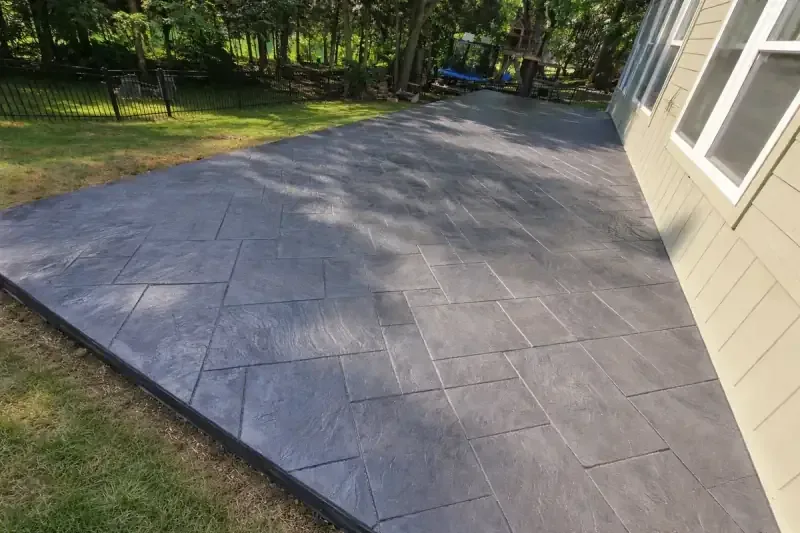
Stamped Concrete in Blue Springs, MO
Your Blue Springs neighbors aren't pouring plain gray anymore. Stamped concrete gives Chapel Ridge and Stone Canyon homes the look of natural stone at a fraction of the cost — and it holds up to Missouri winters.
That fading patio slab behind your house? It's dragging down your entire backyard.
You spend Saturday mornings staring at it through the kitchen window. That plain concrete patio has turned chalky gray after fifteen Missouri summers. Hairline cracks run through it like tiny rivers. The surface flakes near the grill. You've pressure washed it twice this year, and it still looks tired. Every cookout in your Saddle Ridge backyard feels a little less inviting because of it.
Stamped concrete solves that problem in a single pour. We remove the old slab and replace it with a surface that mimics flagstone, slate, brick, or even wood plank. The color goes deep into the mix — it won't peel or fade like a topical coating. Blue Springs homeowners along Woods Chapel Road and throughout Copper Leaf have made this upgrade, and the results speak from the curb.
This isn't a decorative afterthought. Stamped concrete is structural. It carries the same load ratings as standard concrete but delivers the visual impact of premium hardscaping. A well-poured stamped patio or driveway in Jackson County adds real resale value. Appraisers notice. Buyers notice. Your neighbors definitely notice.
Since 2015, we've completed 377 projects across the Kansas City metro. Thirteen five-star Google reviews back up our work. Blue Springs is one of our most active service areas — we know the soil here, we know the drainage patterns off the hills near Fleming Park, and we know how to build slabs that survive December.
What Stamped Concrete Actually Looks Like in a Blue Springs Yard
Most of our Blue Springs stamped concrete projects fall into three categories: backyard patios, front walkways, and driveway aprons. Patios are the most popular by far. Homeowners in Whitetail and Chapel Ridge typically choose ashlar slate or random stone patterns in earth tones — warm browns, tans, and charcoal accents that complement the brick and stone siding common throughout these neighborhoods. The finished surface looks like individually laid stone, but it's one continuous slab with no weeds growing between joints.
Driveways get a different treatment. We typically pour stamped driveways at six inches thick with fiber mesh reinforcement and saw-cut control joints every ten feet. A cobblestone or herringbone brick pattern gives a Blue Springs driveway serious curb appeal without the settling and shifting you get with individual pavers on Jackson County clay. The integral color runs through the full depth of the pour, so minor surface wear won't reveal gray underneath.
We also pour stamped walkways, pool surrounds, and outdoor kitchen pads. Several projects near Adams Pointe Golf Club have included multi-pattern designs — a large-format stone field with a contrasting brick-style border. Color hardener applied to the surface adds depth and UV resistance. A quality acrylic sealer locks it all in and gives the surface a subtle sheen that makes the pattern pop.
Blue Springs-Specific Stamped Concrete Considerations
Jackson County Clay and Why Your Base Prep Matters More Here
Blue Springs sits on heavy clay soil that expands when wet and contracts when dry. This seasonal movement cracks poorly supported slabs. We excavate a full eight inches below grade and install four inches of compacted Class 5 limestone base before any concrete touches the ground. On properties near Blue Springs Lake or in lower areas around Pink Hill Park where water tables run higher, we add a drainage layer of clean rock beneath the base. This prep work takes an extra day. It saves your slab for twenty years.
HOA Design Standards in Blue Springs Subdivisions
Several Blue Springs neighborhoods have architectural review boards that regulate exterior changes. Stone Canyon and Copper Leaf both require pre-approval for driveway modifications and patio expansions visible from common areas. We've worked with these HOAs before. During your site visit, we'll identify any restrictions that apply to your lot and help you select patterns and colors that satisfy the guidelines. We provide detailed project renderings that make the approval process faster. No surprises after the pour.
Freeze-Thaw Exposure on East-Facing Properties
Blue Springs gets around 22 freeze-thaw cycles per winter. East-facing slabs catch morning sun after overnight freezes, creating rapid temperature swings that stress the surface. Homes along the east side of MO-7 and properties facing Fleming Park are especially exposed. We address this with air-entrained concrete mixes that contain microscopic air bubbles — these give expanding ice room to move without fracturing the surface. Combined with a resealing schedule every two to three years, your stamped concrete handles Missouri winters without spalling or flaking.
From First Call to Finished Patio — Your Blue Springs Project Start to Finish
It starts with a phone call or online form. You tell us what you're thinking — maybe a stamped patio to replace that cracked slab, maybe a new walkway from the driveway to the front door. We schedule a site visit within a few days, usually around your work schedule since most Blue Springs homeowners commute along I-70 or Adams Dairy Parkway and need afternoon or weekend availability.
At your property, one of our contractors walks the project area with you. We check the existing grade, identify where water currently drains, and note any obstacles — downspouts, tree roots, utility lines, AC units. In neighborhoods like Saddle Ridge and Chapel Ridge, we often find that original builder-grade patios were poured too thin with no proper base. We'll show you exactly why the old slab failed so the new one won't. Before leaving, we take measurements and discuss pattern options. Most homeowners narrow it down to two or three favorites. Within 48 hours, you get a detailed written estimate with material specs, timeline, and total cost.
Pour day is where it gets exciting. Our crew arrives early, usually by seven. The forms are already set from prep day. We pour the concrete in sections, apply the integral color, then hand-stamp each section using the pattern mats you selected. Timing is everything — the concrete needs to be firm enough to hold the impression but soft enough to take detail. Our contractors have poured hundreds of stamped slabs. They read the surface by feel and adjust throughout the day. By late afternoon, your new patio has shape, color, and texture.
Two days later, we return to wash off the release agent, inspect every square foot, and apply the first coat of acrylic sealer. You walk the finished surface with us. We point out the control joints, explain the curing timeline, and give you a printed maintenance guide specific to Blue Springs weather. Most homeowners are grilling on their new patio within a week.
How Much Does Stamped Concrete Cost in Blue Springs?
| Type | Cost / Sq Ft | Typical 300 Sq Ft |
|---|---|---|
| Basic Patterns (1 color) | $12–15 | $3,600–$4,500 |
| Premium Patterns (2 colors) | $15–18 | $4,500–$5,400 |
| Multi-Color / Custom | $16–20 | $4,800–$6,000 |
Stamped concrete in Blue Springs typically runs between $12 and $18 per square foot installed, depending on pattern complexity and color choices. Properties with steep grades near Fleming Park or Blue Springs Lake may require additional excavation and base work, which can add $1 to $3 per square foot.
Stamped Concrete FAQ for Blue Springs, MO
What stamped concrete patterns are most popular in Blue Springs neighborhoods?
Ashlar slate and random stone patterns dominate in Blue Springs. These work well with the earth-toned brick and stone exteriors common in Stone Canyon, Copper Leaf, and Chapel Ridge. Cobblestone borders are a popular accent. We bring physical samples to your site visit so you can see how different patterns look against your home's siding and landscaping. Herringbone brick is gaining popularity for walkways and smaller patios where homeowners want a more traditional look.
How does Blue Springs weather affect the best time to pour?
We pour stamped concrete in Blue Springs from late March through mid-November. The ideal window is April through June and September through October — moderate temperatures give us the best control over curing and stamping timing. Summer pours work fine, but temperatures above 90 degrees accelerate curing, which means our crew works faster during the stamping phase. We avoid pouring when overnight lows drop below 40 degrees. If your project is scheduled for spring, booking in January or February locks in your spot before the seasonal rush.
Can stamped concrete fix the drainage problems in my backyard?
Yes, and this is one of the biggest advantages over pavers or loose materials. We pour stamped concrete with intentional slope — typically a quarter inch per foot away from your foundation. Many Blue Springs backyards, especially in older sections near Burrus Old 40 Park, have patios that settled over the years and now direct water toward the house. A new stamped slab corrects that grade. We can also integrate channel drains or French drain connections into the project to handle heavier water flow from downspouts or hillside runoff.
Will road salt from my driveway damage stamped concrete?
Standard rock salt can damage any concrete surface over time by accelerating freeze-thaw spalling. We recommend calcium magnesium acetate or sand for traction on stamped driveways. The acrylic sealer we apply provides a barrier against salt penetration, but resealing every two to three years is essential for driveways that see winter deicing. Homeowners near MO-7 and US-40 sometimes get road salt spray from passing traffic — the sealer handles that exposure as long as it's maintained.
How wide should a stamped concrete walkway be?
We recommend a minimum of four feet for front walkways so two people can walk side by side comfortably. For side-yard paths or garden walkways, three feet works. In Blue Springs subdivisions with longer front yards — common in Whitetail and parts of Saddle Ridge — a wider five-foot walkway with a decorative border creates a more substantial look that matches the scale of the house. We set the width during the site visit based on your lot layout and how you use the space.
Do you remove and haul away the old concrete?
We handle full demolition and removal of existing slabs as part of the project. Our crew breaks the old concrete with a skid steer or jackhammer, loads it into a dump trailer, and hauls it to a Jackson County recycling facility. Removal cost depends on the slab thickness and accessibility — a standard four-inch patio on a level Blue Springs lot is straightforward. Thicker slabs or patios with limited access behind the house may add to the removal estimate. We include this line item in your written quote so there are no surprises.
Other Concrete Services in Blue Springs, MO
Schedule Your Free Blue Springs Property Assessment
We'll walk your property, check the soil conditions and drainage grade, evaluate any existing concrete, and give you a detailed estimate for your stamped concrete project — all at no cost. Call today or fill out the form to get on our schedule.