
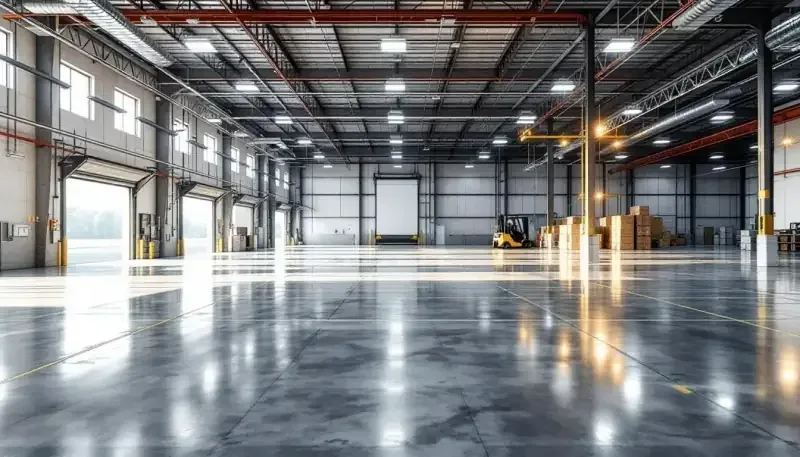
Warehouse & Industrial Floors in Blue Springs, MO
Blue Springs businesses along North 7 Highway Industrial and the Adams Dairy corridor need floors that handle real punishment. We pour slabs engineered for Jackson County clay and heavy daily loads.
What Does a Warehouse Floor Actually Cost in Blue Springs?
Let's talk numbers first. A warehouse or industrial floor in Blue Springs typically runs between $5.50 and $9.00 per square foot for a standard 6-inch reinforced slab. That range shifts depending on subbase prep, thickness, joint layout, and whether you need hardeners or coatings. A 15,000-square-foot pour might land between $82,000 and $135,000. Those aren't guesses. They reflect real pricing from our 377-plus completed projects across the Kansas City metro since 2015.
Why the wide range? Jackson County soil is the biggest variable. Blue Springs sits on expansive clay that swells when wet and shrinks when dry. That movement will crack a poorly prepared slab within two years. Proper subbase stabilization adds cost upfront but saves you from a six-figure replacement down the road. We'd rather have that honest conversation now than watch your floor fail later.
Labor and material costs in the KC metro have climbed roughly 18 percent since 2021. Ready-mix concrete from local batch plants near I-70 runs about $145 to $160 per cubic yard depending on PSI spec. Rebar and fiber mesh pricing fluctuates seasonally. Fuel surcharges on delivery trucks affect every pour. These aren't abstract market forces. They show up line by line on your estimate.
The good news: Blue Springs offers some logistical advantages. Proximity to I-70 means shorter haul distances from batch plants east of Kansas City. North 7 Highway Industrial sites are easy to access with pump trucks and heavy equipment. Less mobilization time means lower labor hours. We pass those savings through because they're real and measurable.
Industrial-Grade Concrete Floors Built for Blue Springs Operations
Blue Springs has evolved from a bedroom community into a city with serious commercial and light-industrial infrastructure. The North 7 Highway Industrial corridor and properties along Old 40 Highway support distribution centers, manufacturing operations, and high-traffic retail warehousing. These facilities demand floors that resist point loads from racking systems, abrasion from forklift traffic, and joint deterioration from thermal cycling. We design and pour slabs ranging from 5,000 to 6,000 PSI with fiber reinforcement and strategic joint placement to handle exactly those conditions.
Many warehouse floors in Blue Springs date to the original commercial boom of the 1970s and 1980s. Those slabs have long exceeded their structural lifecycle. We see common failures: widespread map cracking, deteriorated control joints, surface spalling from deicing chemicals tracked inside, and curling at slab edges caused by moisture differential. Full-depth replacement is often more cost-effective than repeated patching. We remove the failed slab, regrade and stabilize the subbase, and pour a new floor designed for another 30-plus years of service.
Our industrial floor work includes joint layout engineering, vapor barrier installation, proper cure-time protocols, and optional surface treatments like lithium densifiers or epoxy-urethane coatings. We coordinate directly with your racking installers, dock equipment vendors, and facility managers. Every pour is laser-screed leveled to meet FF/FL flatness and levelness standards appropriate for your equipment. If you're running narrow-aisle reach trucks, we hit tighter tolerances. If you're running standard counterbalance forklifts, we spec accordingly.
Blue Springs-Specific Warehouse & Industrial Floors Considerations
Jackson County Clay and Subbase Engineering
Blue Springs soil is predominantly high-plasticity clay with a plasticity index often exceeding 30. This means dramatic volume changes with moisture fluctuation. We address this with a minimum 6-inch compacted aggregate subbase, sometimes incorporating lime stabilization when soil testing reveals extreme expansion potential. Every project starts with a geotechnical evaluation. Skipping this step is how floors fail in three years instead of thirty.
Forklift and Point-Load Traffic Patterns
Distribution and warehouse operations in Blue Springs range from light pallet storage to heavy manufacturing with CNC equipment and loaded semi-trailers inside the building. We design slab thickness, reinforcement schedules, and joint spacing around your actual load data. A floor supporting static racking loaded to 3,000 pounds per post needs different engineering than a floor handling 15,000-pound forklift wheel loads. We calculate these figures before we ever order concrete.
Aging Infrastructure Along Old 40 and MO-7
Many Blue Springs industrial properties along the 7 Highway Retail Corridor and Old US-40 were built decades ago. These buildings often have outdated drainage, deteriorated vapor barriers beneath existing slabs, and floor elevations that no longer match modern dock equipment. Our replacement projects frequently include regrading for proper drainage pitch, new 15-mil vapor barriers, and elevation adjustments to align with current dock levelers and overhead door thresholds.
Minimizing Operational Downtime
Shutting down a warehouse costs money every single day. Blue Springs businesses along Adams Dairy Parkway and North 7 Highway can't afford weeks of total closure. We phase our pours so you maintain partial operations throughout the project. Typically we work in sections of 3,000 to 5,000 square feet, allowing a 72-hour cure window per section before light traffic resumes. Full forklift loads at seven days. Your operations manager gets a detailed phasing schedule before we mobilize.
How We Build Warehouse Floors in Blue Springs — A Technical Walkthrough
Every project starts with boots on your slab. We core-sample the existing floor to evaluate thickness, reinforcement condition, and subgrade quality. If we're working with a 1970s-era slab near the Old 40 corridor, we often find unreinforced concrete poured directly on native clay with no vapor barrier. That tells us everything about why the floor failed. We send soil samples to a local geotech lab for Atterberg limits testing. In Blue Springs, we routinely see liquid limits above 50 and plasticity indices in the low 30s. That data drives our subbase design.
Demolition is methodical. We saw-cut the existing slab into manageable sections, break them with hydraulic hammers, and load out debris using skid steers and roll-off dumpsters. For phased projects, we install temporary barricades between active work zones and your operating areas. Once the old slab is removed, we excavate to design depth and proof-roll the subgrade with a loaded dump truck. Soft spots get undercut and replaced with compacted Class 5 aggregate. We compact in 4-inch lifts using a vibratory roller, testing density with a nuclear gauge at multiple points across the floor area.
Forms go in next, laser-set to elevation. We install 15-mil vapor retarder with sealed seams, then place reinforcement — typically number 4 rebar on 18-inch centers both ways, supported on chairs at mid-depth. For heavier load applications, we upgrade to number 5 bars or add supplemental fiber reinforcement. Ready-mix arrives from batch plants along the I-70 corridor, usually specced at 4,500 to 6,000 PSI with a moderate slump for pump placement. Our crew places, consolidates, and screeds using a laser screed machine that delivers consistent FF50/FL30 or better flatness across the entire pour.
Finishing and curing are where good floors separate from great ones. We apply a power trowel finish calibrated to the surface treatment you've selected — burnished for densifier application, profiled for epoxy coating. Curing compound goes on within 30 minutes of final finish. We protect fresh slabs with barricades and signage for a minimum 72-hour initial cure. Saw-cut control joints are placed at calculated intervals within 12 to 18 hours, timed based on ambient temperature and concrete set behavior. In Blue Springs summers, that window tightens. We monitor it continuously.
From Crumbling Slab to Load-Ready Floor on North 7 Highway
A building owner operating a 22,000-square-foot distribution facility near the North 7 Highway Industrial corridor contacted us after noticing progressive joint failure across roughly 60 percent of the warehouse floor. Forklifts were catching on spalled joint edges, damaging product and creating safety hazards. The original slab — poured in 1983 — was only 4 inches thick with no vapor barrier and minimal reinforcement. Core samples confirmed the concrete had dropped below 3,000 PSI. The subgrade was saturated native clay with no aggregate base layer.
We designed a phased replacement plan that kept half the warehouse operational at all times. Our crew demolished and replaced the floor in four sections over six weeks. Each section received 8 inches of compacted Class 5 limestone base, a 15-mil vapor retarder, number 4 rebar on 16-inch centers, and 6 inches of 5,000 PSI concrete placed with a laser screed. We installed armored construction joints at section boundaries and saw-cut control joints at 12-foot spacing. The surface received a lithium silicate densifier for abrasion resistance.
The result: a floor rated for 8,000-pound point loads with FF45/FL30 flatness numbers. The owner's reach trucks now operate smoothly without the jarring impacts from failed joints. Total project cost came in at $7.85 per square foot — roughly $172,000 — including demolition, haul-off, subbase work, concrete, and densifier application. That facility is set for the next three decades.
How Much Does Warehouse & Industrial Floors Cost in Blue Springs?
| Type | Cost / Sq Ft | Project Dependent |
|---|---|---|
| Standard Industrial Slab | $3–6 | Varies by scope |
| Polished Concrete | $5–10 | Varies by scope |
| Epoxy / Coating System | $4–8 | Varies by scope |
Warehouse floor pricing in Blue Springs benefits from shorter concrete delivery hauls off I-70, but Jackson County's expansive clay often requires additional subbase stabilization that adds $0.75 to $1.50 per square foot compared to sites with stable subgrade.
Warehouse & Industrial Floors FAQ for Blue Springs, MO
What concrete mix design works best for Blue Springs warehouse conditions?
We typically specify a 4,500 to 6,000 PSI mix with a 0.45 or lower water-cement ratio. The exact design depends on your load requirements, exposure conditions, and whether the floor will receive a coating or densifier. For cold-storage facilities, we use air-entrained mixes to resist freeze-thaw damage. For heavy forklift operations, we add synthetic macro-fibers for secondary crack control. Our batch plants along the I-70 corridor can produce custom mix designs with consistent quality control.
How do you prevent moisture-related floor failures?
Moisture vapor transmission is the leading cause of coating delamination and flooring adhesion failures. We install a 15-mil polyolefin vapor retarder directly beneath the slab with all seams taped and sealed. Before applying any coating or topping, we perform calcium chloride moisture testing per ASTM F1869 and relative humidity testing per ASTM F2170. In Blue Springs, the high clay content in native soil creates elevated moisture conditions. Our subbase design includes a capillary break layer of clean crushed stone that interrupts moisture wicking from the subgrade.
Can you install trench drains or floor drains as part of the project?
Absolutely. We install trench drains, area drains, and sloped drainage channels during the pour. Drain placement is coordinated with your plumber and your facility's connection to the municipal storm or sanitary system. For food processing or wash-down environments, we pitch the floor at a minimum one-eighth inch per foot toward drains. Blue Springs plumbing permits are handled through the city's community development department, and we coordinate that paperwork as part of our scope.
What happens if we discover contaminated soil during demolition?
It happens occasionally, especially in older industrial properties along MO-7 and Old 40 Highway. If our excavation reveals stained soil, unusual odors, or suspect materials, we stop work in that area and recommend environmental testing. We don't perform remediation ourselves, but we coordinate with licensed environmental contractors in the KC metro. The contaminated material must be properly characterized and disposed of before we proceed with subbase preparation. This can add time and cost, which is why we flag the possibility during our initial site evaluation.
Do you handle ADA-compliant transitions at doorways and loading docks?
Yes. Floor elevation changes at doorways, dock areas, and pedestrian access points must meet ADA slope requirements. We pour transitions with a maximum 1:12 slope ratio for ramps and ensure thresholds don't exceed half-inch vertical changes. For loading dock areas, we coordinate floor elevation with your dock leveler pit dimensions and overhead door sill heights. Getting these details right during the pour prevents costly grinding or modification later.
How soon after the pour can we install racking and equipment?
Light foot traffic is safe at 48 to 72 hours. We allow forklift traffic at seven days under normal curing conditions. Racking installation with anchor bolt drilling can begin at 14 days, when the slab has reached approximately 75 percent of its design strength. Full design load — including loaded racking, heavy equipment placement, and normal operations — is appropriate at 28 days. Blue Springs summer heat can accelerate early strength gain, while winter pours may require longer cure windows. We provide a project-specific timeline based on your pour date and conditions.
Other Concrete Services in Blue Springs, MO
Request a Callback About Your Warehouse Floor
Leave your number and project details. We return calls within two hours during business days and serve all of Blue Springs — from Adams Dairy Landing to the North 7 Highway Industrial corridor.