Commercial Sitework Contractor in Overland Park, KS
From raw ground to finished concrete — one crew handles excavation, grading, utilities, demolition, erosion control, and the concrete pour that follows. Built for Overland Park, KS GCs, developers, and property managers who cannot afford coordination gaps between subs.
Commercial Sitework in Overland Park — What You're Actually Buying
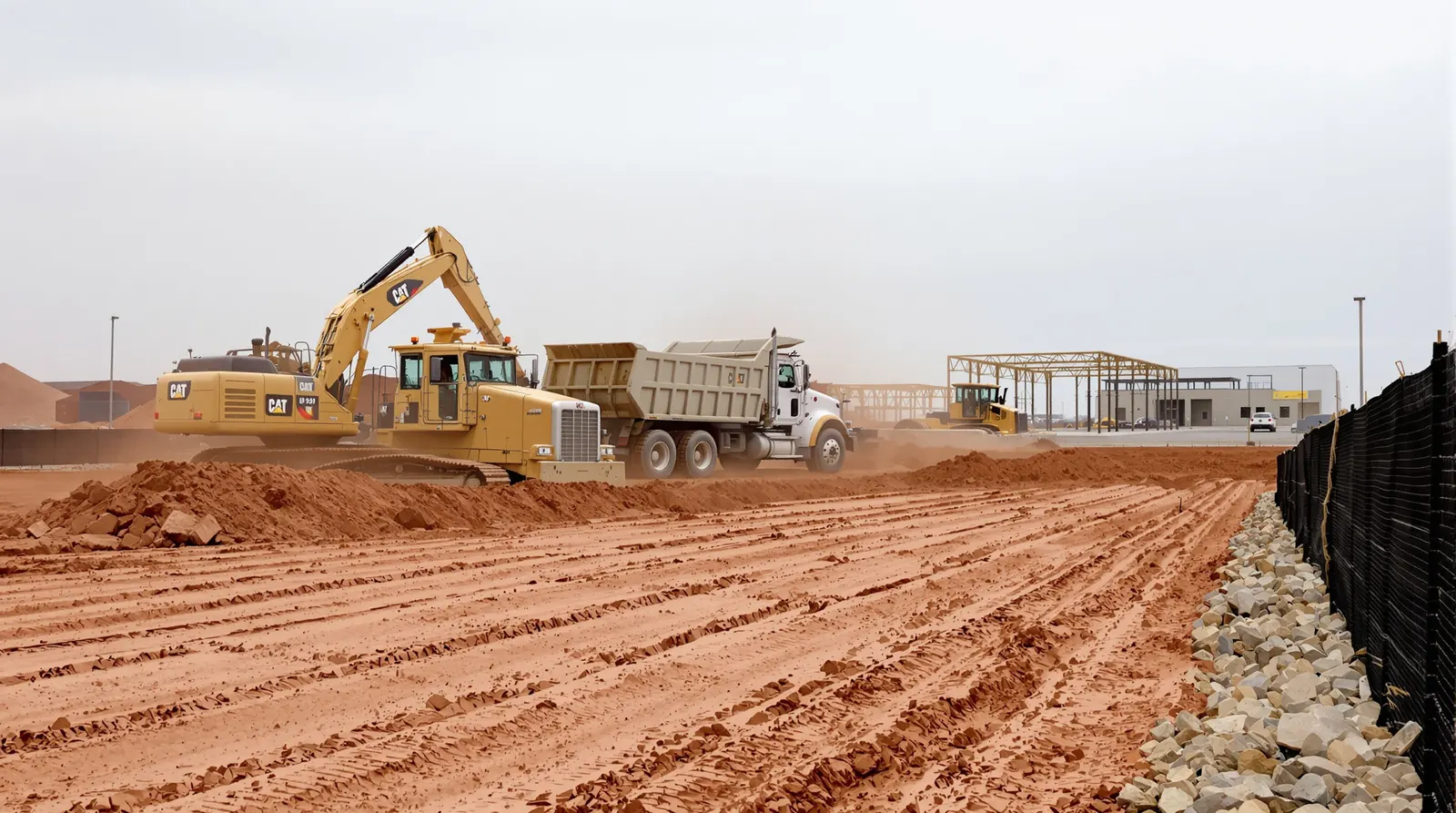
Overland Park is a high-volume Class A office, healthcare, and retail commercial sitework in the strictest-code jurisdiction in Johnson County market. Overland Park is the highest-volume commercial sitework market on the Kansas side. Continued Class A office and mixed-use development in the Corporate Woods corridor, ongoing healthcare campus expansion around AdventHealth Shawnee Mission, and major retail and lifestyle development at Bluhawk and Hartman Heritage are driving consistent demand. The Aspiria redevelopment of the former Sprint campus is one of the largest infill commercial projects in Johnson County history — multi-phase, multi-year, and actively under construction. The work we deliver here spans the full sitework scope: excavation, grading and sub-base preparation, utility trenching, demolition, and SWPPP-compliant erosion control.
The 119th and 135th Street commercial corridors remain the highest-volume retail and medical office development corridors in the metro. Oracle (Cerner), T-Mobile, Black & Veatch, and AdventHealth are all anchored here with major facilities. OP Planning enforces the strictest pavement and landscaping codes in Johnson County — contractor quality standards are higher here than anywhere else in the metro, and bid quality reflects it.
Overland Park sits on Wymore-Ladoga clay (CH/CL) with very high shrink-swell across the entire city — moisture control during compaction is the single most common failure point on OP commercial pads, with 10–30+ feet of clay overburden across most of OP, with limestone coming up shallower south of 159th Street. Those soil conditions drive how we sequence excavation, how we moisture-condition fill placement, and how we set realistic schedules. The primary site-specific risks here are very high shrink-swell clay requiring tight moisture control during compaction, large-scale parking lot pad preparation, integration with existing infrastructure on infill sites, and strict OP Planning code compliance.
Overland Park requires a grading permit for any disturbance over 5,000 SF or 100 cubic yards through OP Planning. Stormwater management plan required for sites over 1 acre. Permit review typically runs 2–3 weeks — the fastest in the metro. KDHE NPDES handled in parallel through KEIMS. Permitting on the Kansas side runs through Kansas Department of Health and Environment (KDHE) for any project disturbing 1 acre or more, plus the city-level grading permit. We file every permit application on your behalf and start the process the day a contract is signed — because permit delays are the #1 cause of schedule slippage on commercial sitework in this metro.
The single biggest reason commercial pads fail to deliver on schedule in Overland Park is the handoff between the sitework sub and the concrete sub. Each waits on the other, the schedule slips a week, the slab gets poured on a sub-base nobody fully owns, and the cracks show up 12 months later. Kansas City Concrete Contractors handles the entire sequence under one contract — site prep, sub-base, and the concrete pour by the same crew. View the full sitework hub for the complete scope.
Kansas Side Regulatory Reality
KDHE NPDES Construction Stormwater Permit. Required for any project disturbing 1 acre or more on the Kansas side. Filed through KEIMS, the KDHE electronic filing system, with a $90 application fee and a 10–20 business day review window. Kansas requires a Kansas-licensed Professional Engineer to supervise the SWPPP — we coordinate with licensed PEs on every Kansas-side project.
City of Overland Park grading permit. Overland Park requires a grading permit for any disturbance over 5,000 SF or 100 cubic yards through OP Planning. Stormwater management plan required for sites over 1 acre. Permit review typically runs 2–3 weeks — the fastest in the metro. KDHE NPDES handled in parallel through KEIMS.
SWPPP installation, inspection, and closeout. Erosion control BMPs go in before any other site disturbance — that is a permit requirement, not a recommendation. Inspections happen every 7 days plus within 24 hours of any rain event over 0.5 inches. Closeout requires 70% permanent vegetative cover and a Notice of Termination filed with KDHE. We handle every step.
Why Overland Park GCs Hire Us for the Full Scope
When sitework and concrete are handled by separate subs, there is always a 1 to 3 week gap between the sitework crew finishing sub-base preparation and the concrete sub mobilizing to pour. During that gap rain compromises the grade, traffic ruts the surface, and settlement happens. The concrete sub arrives, finds the prepared base is no longer the same base they bid against, and either re-works it (delay) or pours over it anyway (failure later).
Kansas City Concrete Contractors delivers the full sequence under one contract: Overland Park parking lots, warehouse and industrial floors, ADA-compliant ramps and curb cuts, and sidewalks and walkways — all poured by the same crew that prepared the sub-base. Same equipment, same crew, same warranty covering both phases.
For Overland Park GCs and developers, that means one phone number, one schedule, one bid that breaks out earthwork, utilities, sub-base, and concrete as separate line items so you can compare apples to apples. No finger-pointing if anything goes wrong. No coordination penalty added to the schedule. No 2-week dead zone in the middle of the build.
What's in the Scope
Excavation
Mass earthwork, precision excavation, rock excavation, backfill, and verified compaction.
Grading
Rough and fine grading, GPS machine control, sub-base preparation to spec.
Utility Trenching
Sanitary, storm, water, electric, gas, telecom — with proper bedding and 811 compliance.
Demolition
Slab, structural, and selective demolition with concrete recycling and haul-off.
Land Clearing
Trees, brush, stumps, grubbing, and topsoil strip with full debris haul-off.
Erosion Control & SWPPP
KDHE permit filing, BMP installation, weekly inspections, and NOT closeout.
Sitework FAQ for Overland Park, KS
How long does an Overland Park grading permit take?
OP grading permits typically run 2 to 3 weeks through OP Planning — the fastest review window in the metro for commercial projects. Stormwater management plans for sites over 1 acre are reviewed in parallel rather than sequentially, which compresses the total timeline. KDHE NPDES filing through KEIMS adds 10 to 20 business days, but we file both simultaneously on the day a contract is signed. Total permit lead time on a typical OP commercial project is 3 to 5 weeks, significantly faster than KCMO. If you have civil plans ready before contracting, we can start the permit application during the bid review period and shorten the pre-construction window further.
How does OP clay affect compaction, and how do you manage it?
Overland Park sits on Wymore-Ladoga clay with very high shrink-swell behavior. Achieving compaction requires holding soil moisture within 2% of optimum — typically 16 to 20% for a modified Proctor test — while placing and compacting each lift. We test every lift at depth with a nuclear density gauge, not just the surface. The narrow moisture window is the single most common reason commercial pads fail compaction tests in this market: clay that is too dry will not compact; clay that is too wet pumps under load. We add water or aerate as needed lift-by-lift rather than trying to correct the whole pad at the end. This adds time but prevents the expensive failed-compaction-test scenario.
Do you handle the Corporate Woods and College Boulevard office corridor work?
Yes — Class A office and medical office campus work in the Corporate Woods and College Boulevard corridors is regular scope for us. Operating office properties have specific constraints: tenant access and parking cannot be fully blocked during business hours, security and access control must be coordinated pre-construction, and noise limits may apply during certain windows. We plan phased site access into every active-property commercial bid so the project does not disrupt the tenants paying your lease. AdventHealth, Oracle, and similar anchor tenants in OP have no tolerance for access failures on their campuses.
What about the large retail corridor work along 119th and 135th?
The 119th and 135th Street corridors are the highest-volume commercial development corridors on the Kansas side. New retail pads, restaurant ground-ups, medical office buildings, and mixed-use projects are active on both corridors year-round. National and regional chains run aggressive ground-break-to-open windows — typically 90 to 120 days from permit to first customer. Single-source sitework and concrete is the model that holds those windows. We have the crew depth and equipment fleet to run parallel scopes — sitework on Phase 1 while utilities are being installed on Phase 2 — which is often the only way to hit chain timelines on multi-tenant developments.
Do you pour the concrete after the sitework in OP?
Yes — same crew, same contract, same warranty from raw ground to finished pavement. Parking lots, loading areas, foundations, ADA ramps, and curb-and-gutter all go in under one scope. For OP projects, that also means the concrete meets OP Planning's quality standards, which are stricter than the general metro baseline. We do not subcontract the concrete pour to a separate crew with different standards. The foreman who grades the pad is the foreman who pours the slab — that is how we maintain quality control across both phases without the coordination gap that causes failures.
Sitework in Nearby Cities
Bidding a Overland Park Commercial Project?
Send us your civil plans. We will return a detailed bid that breaks out earthwork, utilities, sub-base, and concrete as separate line items so you can compare apples to apples — typically within 5 business days.