Commercial Excavation Contractor in Kansas City
Mass earthwork, precision excavation, rock removal, and lift-by-lift compaction testing — performed by the same crew that pours the concrete on top of it. Built for KC clay, KC bedrock, and KC weather.
Why Most Commercial Excavation Bids Fall Apart Before the Dirt Moves
You sent the geotech report to four bidders. Three of them quoted off the same boring log and came back $50,000 apart. Two used a generic 1.15 swell factor — appropriate for sand, not for Wymore-Ladoga CH clay with an AASHTO A-7-6 designation and 60–80% clay content that swells 25–35% when excavated. None of them mentioned the limestone shelf the boring caught at 11 feet on the south end of the pad. The lowest bidder is the one most likely to file a rock excavation change order in week two. The middle bidder is the one most likely to walk after the first week of May rain. You already know how this story ends.
Excavation is the highest-risk phase of any commercial project in this metro. KC's expansive clay punishes contractors who do not understand its moisture sensitivity — optimum compaction window is typically 16–20% moisture content, and material placed 2% wet of optimum pumps under the roller and fails every proctor test. Material placed 2% dry of optimum breaks into hard clods that leave voids compacting under load months later. Bedrock missed in the bid means a change order that can triple the excavation cost on that section. Spring rain that nobody planned for — and May averages 5.2 inches in Kansas City — stretches a 4-week schedule to 8. And the contractor who dug the hole is gone by the time the warehouse floor cracks or the retaining wall settles.
Kansas City Concrete Contractors handles excavation as the first phase of a contract that includes the concrete construction on top of the pad we prepare. We use real KC swell factors — 1.25 to 1.35 based on USCS soil classification at each site. We include a rock contingency line on every bid south of 135th Street. We test every lift of fill with a nuclear density gauge driven to depth, not just the surface — because surface tests pass lifts that are loose below the top 4 inches, and that is exactly how a compacted-looking pad becomes a slab failure 18 months later. And we set the compaction standard based on what the parking lot or building slab above it needs to perform for 25 years — because we are the ones pouring it.
What Does Commercial Excavation in Kansas City Actually Cover?
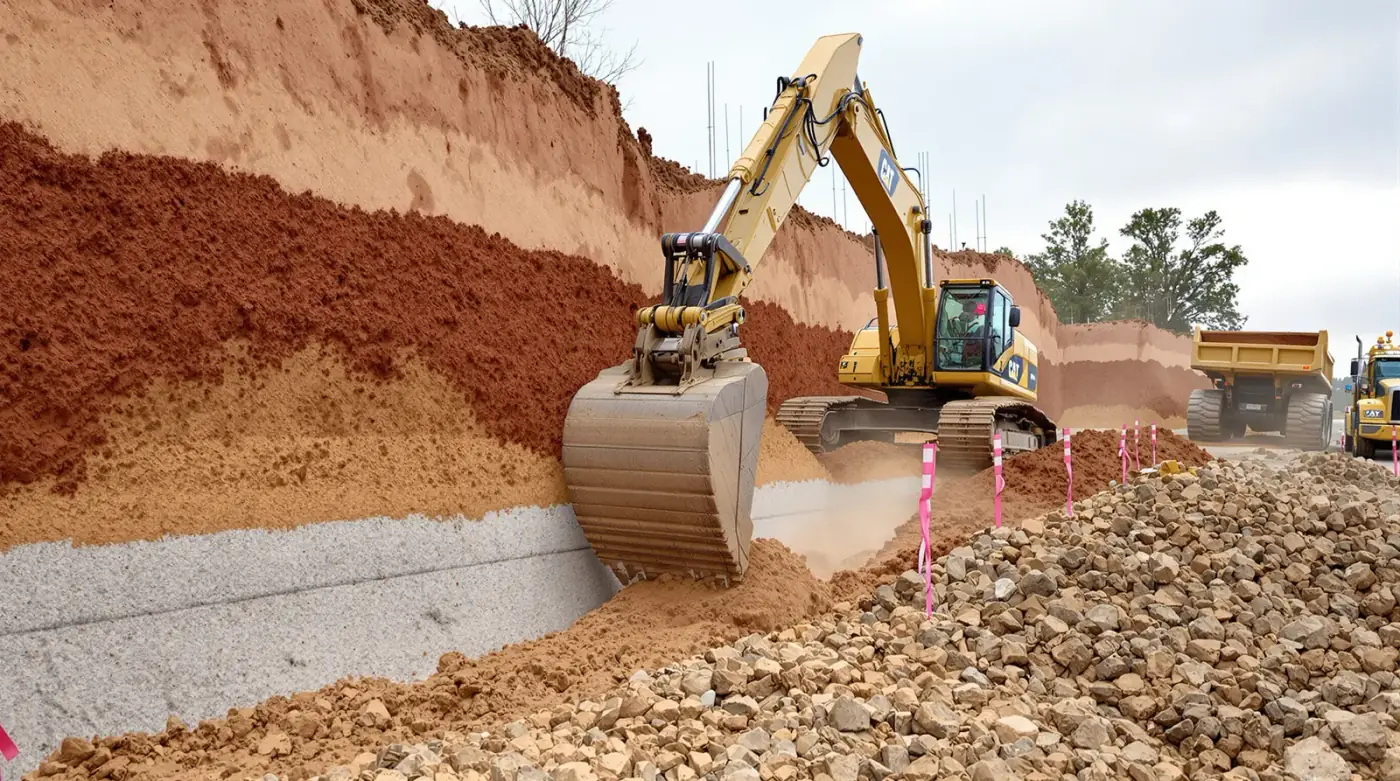
Commercial excavation in the KC metro divides into four distinct categories, each requiring different equipment, sequencing, and pricing logic. Mass excavation is bulk earthwork — the cut/fill operation that establishes building pad and parking elevations across 1 to 10+ acre sites. This is a high-volume, equipment-driven operation. Our mass excavation fleet includes CAT 320 and 330 excavators, CAT D6 and D8 dozers, CAT 950 and 966 wheel loaders, and CAT 621K scrapers for large earthwork moves. GPS machine control on the dozers and excavators reads elevation data directly from the digital civil plan and adjusts the blade automatically, delivering grade tolerances within tenths of a foot without constant survey verification. The equipment runs; the grade follows the plan.
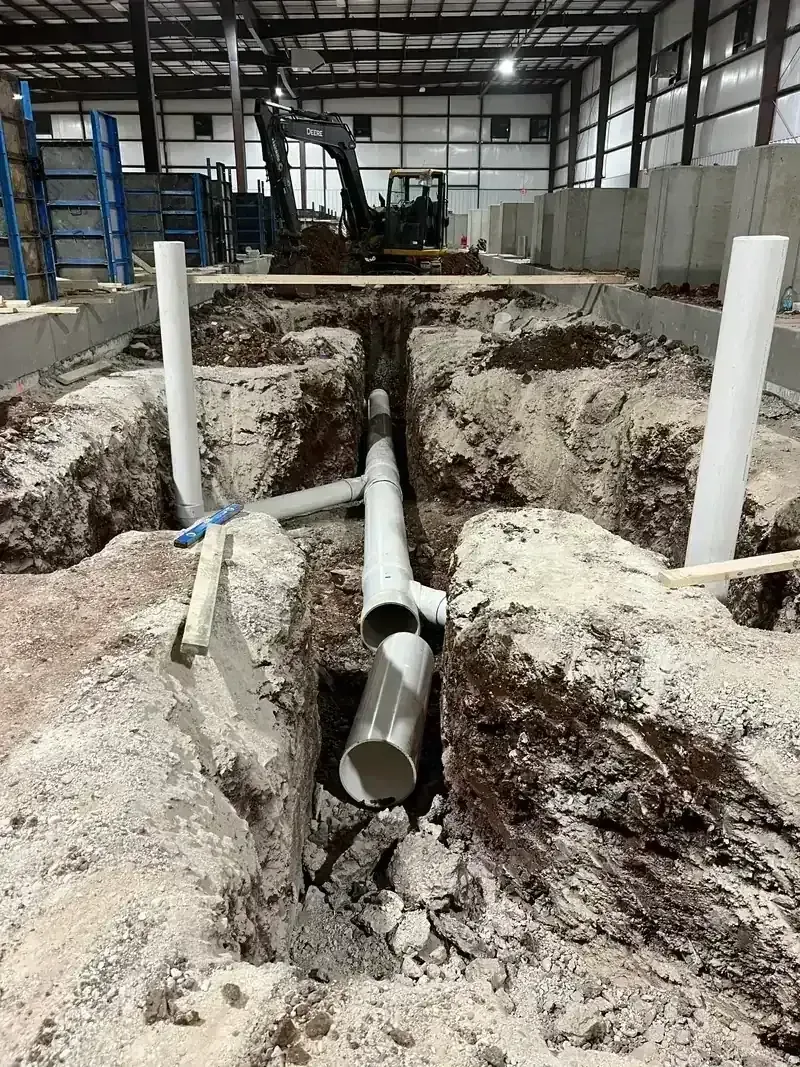
Precision or structural excavation is the opposite end of the spectrum — small-scale, high-tolerance digging for footings, foundations, retaining wall bases, manholes, and pipe vaults. Equipment shifts to mini excavators and skid steers (CAT 259D, Deere 333G), and the focus moves from cubic yards per hour to elevation accuracy and edge protection. Over-excavation beyond the engineer's neat line gets filled with structural material, not native clay — because footings sitting on clay that was disturbed and replaced with more clay will settle unevenly under load. Rock excavation is its own category with its own pricing. In southern Johnson County — Olathe, Gardner, Spring Hill, and any site south of 135th Street — Bethany Falls and Argentine limestone formations appear at 3 to 15 feet. Weathered rock can be ripped with a D8 dozer. Solid formation limestone requires a hydraulic hoe-ram attachment on the excavator. Rock production runs 5–20 cubic yards per hour; clay runs 50–200. The cost difference reflects reality, and any bid that does not account for it is not a complete bid.
Backfill and compaction close every excavation project and determine whether the pad holds up under load over the life of the building. KC clay is placed in 8-inch maximum lifts — the practical limit for sheepsfoot roller compaction in cohesive soil. Each lift is moisture conditioned to within 2% of optimum moisture content (16–20% for most KC clay), spread, compacted, and tested with a nuclear density gauge. Structural fill reaches 95% modified proctor per ASTM D1557. General fill reaches 90%. Granular pipe-zone backfill in utility trenches uses AB-3 (Kansas specification) or Type 5 base rock (Missouri specification) per local standards. Testing happens at full lift depth — not just the surface — because a surface-passing test on a poorly consolidated lift is how the slab problems get planted. Every test result is documented on a compaction report.
Every excavation we perform is the first phase of a longer contract. The sub-base compaction standard matches what the parking lot or sitework scope above it requires. The drainage grade leaving the excavation is sized for the finished site grading that will shed water away from structures. The over-excavation zone around a foundation is sized to allow granular backfill that prevents lateral clay pressure from cracking the wall. We dig the hole with the concrete that fills it already in mind.
OSHA Trench Safety: Subpart P on Every Project
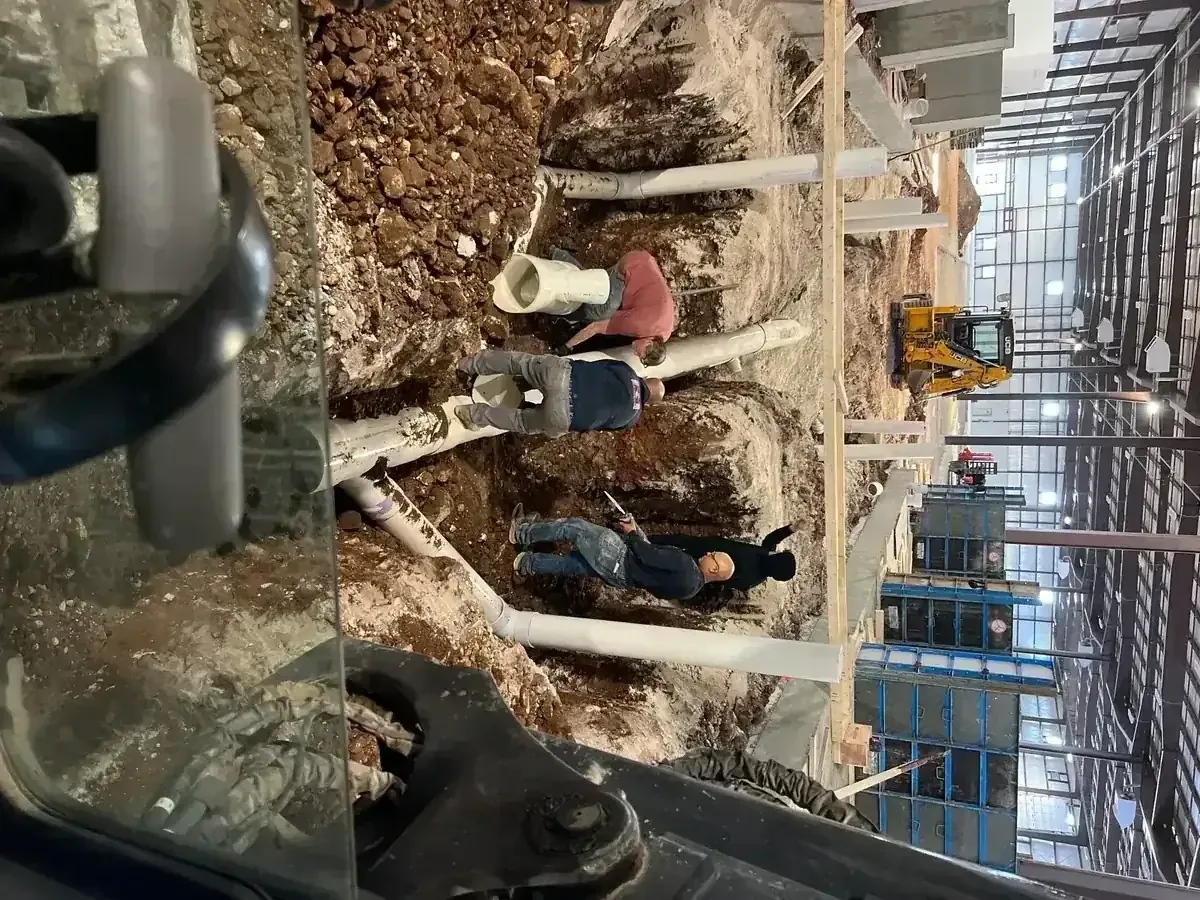
OSHA 29 CFR 1926 Subpart P governs every excavation and trench on a construction site. Any trench 5 feet or deeper requires protection — sloping back to the angle of repose for the soil classification, hydraulic or timber shoring, or a trench box. In KC, most site soils classify as Type C when wet (less than 0.5 tons per square foot unconfined compressive strength), which requires a 1.5H:1V slope ratio or a trench box. A "competent person" must be on site whenever a worker enters any excavation: they classify the soil daily, inspect the excavation before each shift and after any rain event, and document the inspection in writing. We carry trench boxes for every job over 5 feet, have competent persons certified on every crew, and document every inspection. The consequences of non-compliance — a trench collapse — are measured in lives and cannot be undone by any change order.
One more KC-specific reality worth putting in writing: shrink-swell cycling affects finished excavation tolerances. Grades set on KC clay in dry summer conditions will shift when fall rains arrive — the clay absorbs moisture and heaves, raising grades that were set low. Grades set in wet spring conditions will drop when summer drying occurs. Smart excavation contractors compensate by setting pad elevations slightly high in wet conditions, slightly low in dry, and verifying one final time after one wet/dry cycle. This is the kind of local knowledge that separates a KC excavation contractor from someone who learned the trade somewhere else and is learning KC clay on your project.
Your Commercial Excavation Project in 4 Steps
Free Consultation
We visit your property, discuss your vision, and provide a detailed estimate with no obligation. Every question answered up front.
Design & Planning
Choose your materials, finish, and layout. We create a plan tailored to your property and KC's soil and climate conditions.
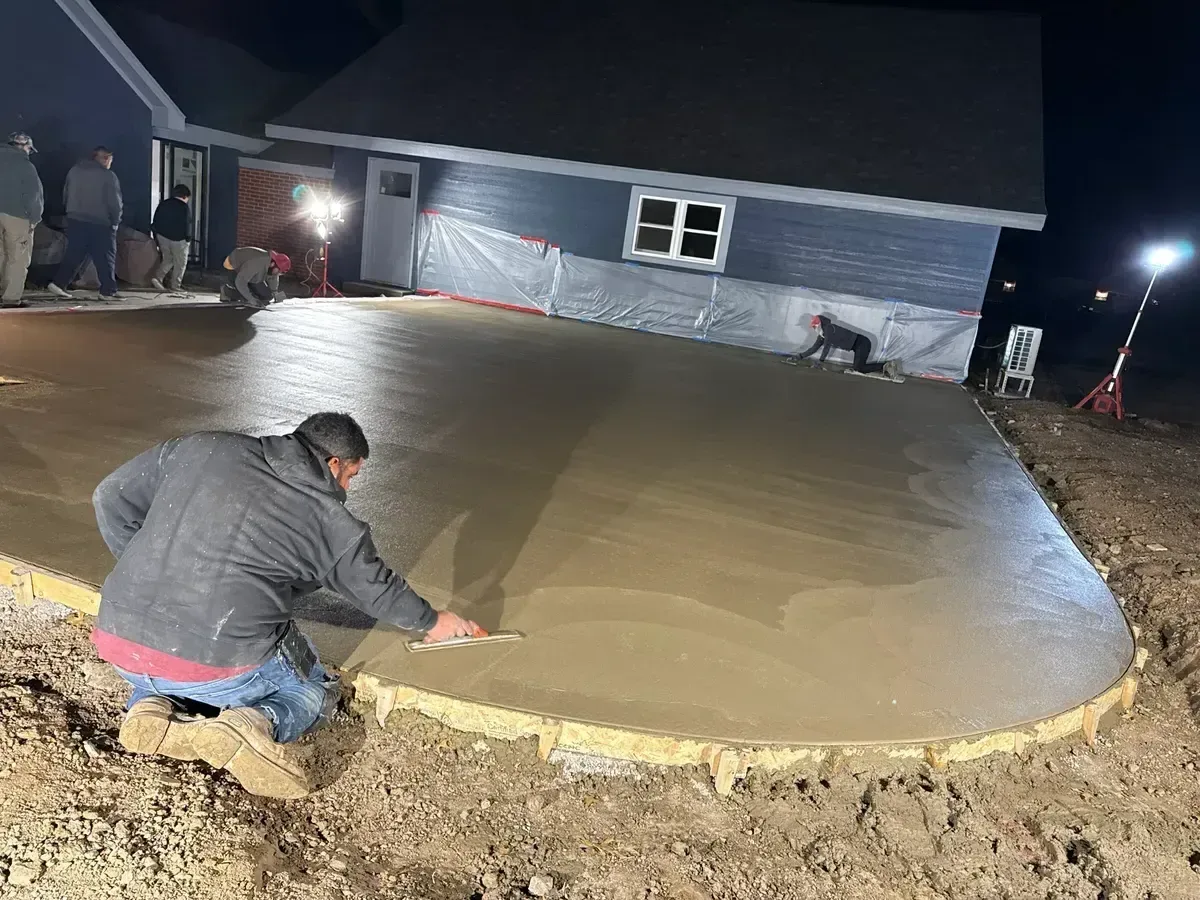
Professional Installation
Our crew preps the site, pours, and finishes your concrete with precision. Most residential projects wrap in 1-4 days.
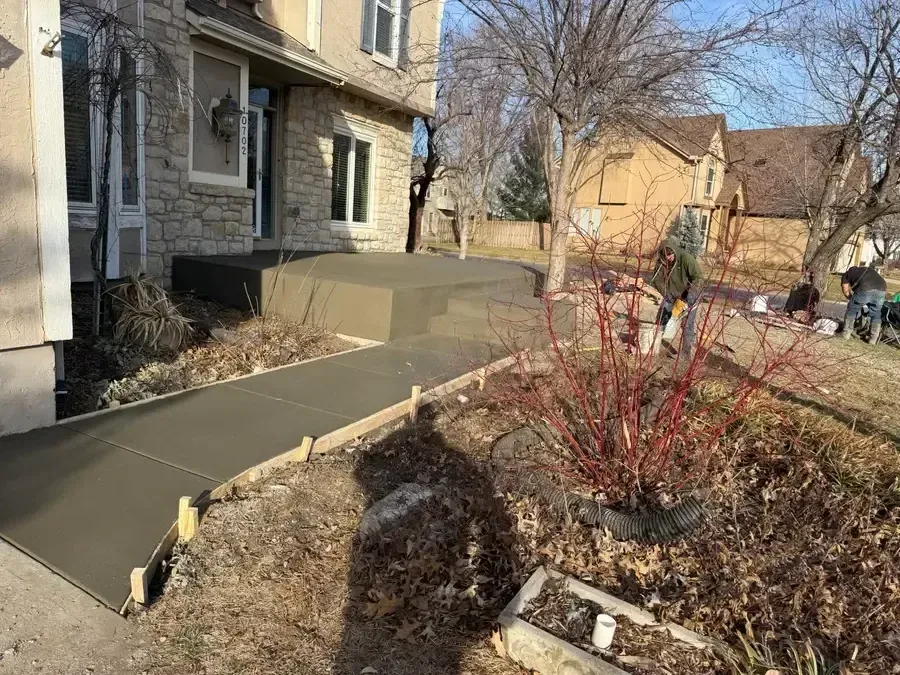
Final Walkthrough
We inspect every inch with you. Sealant applied where needed. We don't leave until you're completely satisfied with the result.
Why Choose Kansas City Concrete Contractors for Commercial Excavation
Mass, Precision & Rock Excavation
Bulk earthwork for commercial pads, pinpoint structural excavation for footings and foundations, and rock excavation through Bethany Falls limestone in southern Johnson County — handled by the same crew under one contract.
KC Clay Expertise Built In
Wymore-Ladoga clay swells 25–35% bank-to-loose. We calculate truck counts and disposal costs on actual KC swell factors — 1.25 to 1.35 — not the generic 1.15 that leaves other bids short by 10–15%.
OSHA Subpart P Compliance
Competent person on every dig per 29 CFR 1926 Subpart P. Type A/B/C soil classification, trench box shoring on every excavation over 5 feet, and daily inspection documentation — no exceptions.
GPS-Guided Fleet
CAT 320, 330, Komatsu PC210, and Deere 350G excavators with GPS machine control deliver elevations to within tenths of a foot. Fewer survey checks, faster cut cycles, tighter pads.
Lift-by-Lift Compaction Testing
Every lift of fill tested at depth with a nuclear density gauge — not just the surface. Structural fill to 95% modified proctor (ASTM D1557). General fill to 90%. We document every test, every lift.
One Crew: Excavation to Concrete
We dig the hole and pour the concrete that fills it. The sub-base we compact meets the spec for the parking lot, foundation, or warehouse floor we are about to pour — because we are the contractor who has to warrant it.
What Our Customers Say
"They handled mass excavation and the foundation pour for our Olathe retail pad. The geotech report flagged Argentine limestone at 8 feet and they had it priced correctly as a contingency line from day one. Came in on the day they committed to, no change order drama."
— Mark T., Olathe, KS
"Our basement dig in Lee's Summit hit a soft pocket at 6 feet nobody had predicted. They over-excavated, brought in structural fill, compacted in 8-inch lifts, and proved bearing with a nuclear gauge — all in one day. The geotech signed off on it the next morning."
— Janelle B., Lee's Summit, MO
"Hired them for a sloped lot excavation and retaining wall in Leawood. One contractor, one schedule, no finger-pointing between the excavation and the concrete sub. Wall has been through two winters without a millimeter of movement."
— Rich K., Leawood, KS
How Much Does Excavation Cost in Kansas City?
| Excavation Type | Cost / BCY | Notes |
|---|---|---|
| Clay Mass Excavation (on-site reuse) | $8–14 | Standard Wymore-Ladoga CH/CL clay, GPS equipment |
| Clay with Haul-Off | $14–22 | Swell factor 1.25–1.35 applied; includes trucking and disposal |
| Precision / Structural Excavation | $18–30 | Footings, foundations, tight tolerance, mini equipment |
| Rock Excavation (ripping) | $45–65 | Weathered limestone, D8 ripping, southern JoCo |
| Rock Excavation (hoe-ram) | $65–90+ | Solid Bethany Falls / Argentine formation, hydraulic breaker |
Bank cubic yard (BCY) pricing. Mobilization: $1,500–5,000 commercial / $500–1,500 residential. Backfill placement, 8-inch lift compaction, nuclear density testing, and compaction report included on all structural fill work. Rock contingency lines quoted separately on all projects south of 135th Street.
Prices vary by project scope, site conditions, and finish selections. Contact us for your exact quote.
Frequently Asked Questions About Commercial Excavation
How much does excavation cost per cubic yard in Kansas City?
Standard clay excavation in the KC metro runs $8–14 per bank cubic yard (BCY) when material can be reused on site. Clay with haul-off runs $14–22 per BCY — that range accounts for truck loading, hauling, and permitted disposal, and it reflects the actual 1.25–1.35 swell factor for Wymore-Ladoga clay (not the generic 1.15 that underestimates truck counts). Precision or structural excavation for footings and foundations commands $18–30 per BCY because of tighter tolerance requirements and smaller equipment in confined spaces. Rock excavation in southern Johnson County — Bethany Falls and Argentine limestone at 3–15 feet — runs $45–90 per BCY, reflecting hoe-ram or ripping production rates of 5–20 CY per hour versus 50–200 for clay. Mobilization is charged separately: $1,500–5,000 for commercial projects and $500–1,500 for residential. Every bid we provide breaks out BCY, swell factor, haul-off, and disposal so you can compare line by line.
How deep is bedrock in Kansas City?
Bedrock depth varies significantly across the metro. Southern Johnson County — Olathe, Gardner, Spring Hill — typically encounters Bethany Falls or Argentine limestone at 3 to 15 feet below existing grade. These are the projects where a rock excavation contingency line is non-negotiable in the bid. Northern Johnson County (Overland Park, Lenexa, Shawnee) has 10 to 30+ feet of clay overburden before reaching rock. Jackson County runs 8–25 feet. Platte County river bottom areas can have 40–80+ feet of alluvial fill before any bedrock. Wyandotte County is variable — Argentine limestone outcrops near the Kansas River but deeper in upland areas. A geotech boring every 100 feet is the only way to know for any specific site. For any commercial project south of 135th Street in Johnson County, we include a rock contingency line in the bid regardless of what the boring log shows.
What is a swell factor and why does it matter?
Swell factor is the ratio between bank cubic yards (volume in the ground before excavation) and loose cubic yards (volume after digging). KC's Wymore-Ladoga clay has a swell factor of 1.25 to 1.35 — meaning 1,000 BCY excavated produces 1,250 to 1,350 loose CY to haul. This directly affects truck counts, disposal tonnage, and total cost. Bids that use a generic 1.15 swell factor — appropriate for granular soils, not KC clay — will undercount haul trucks by 8–15%, resulting in a bid that looks lower until the disposal invoices come in at the end of the job. We use USCS classification (CH/CL for KC clay, per AASHTO A-7-6/A-6 designations) to determine the correct swell factor for the specific soil at your site and document it in the bid assumptions.
What is the difference between bank cubic yards and loose cubic yards?
Bank cubic yards (BCY) is the volume of soil in its undisturbed, in-place state — the number you get from a site survey or grading plan. Loose cubic yards (LCY) is the volume after excavation, when air voids are introduced and the material expands. All haul-off is priced and hauled in LCY, not BCY, because truck capacity is measured in volume. For KC clay at a 1.30 swell factor, 1,000 BCY equals 1,300 LCY. If a truck holds 16 LCY, that is 81 truck loads — not 63 as a 1.15 factor would suggest. A bid that uses BCY to estimate truck counts and then invoices on LCY will always come in over budget. Every excavation bid we submit specifies both units and shows the conversion math.
Do you handle backfill and compaction, and how is it tested?
Yes — backfill and compaction are part of every excavation scope. KC clay must be placed in 8-inch lifts maximum — that is the practical compaction depth for a vibratory sheepsfoot roller in cohesive soil. Each lift is moisture conditioned to within 2% of optimum (typically 16–20% moisture content for KC clay), spread, compacted, and tested with a nuclear density gauge driven to full lift depth. Surface-only tests pass lifts that are loose below the top 4 inches. Structural fill reaches 95% modified proctor (ASTM D1557); general fill reaches 90%; granular pipe-zone backfill in utility trenches uses AB-3 (Kansas) or Type 5 base rock (Missouri) per local specifications. We document every test result on a compaction report that goes in the project closeout binder.
What is OSHA trench safety and how do you comply?
OSHA 29 CFR 1926 Subpart P governs all excavation and trench safety. Any trench 5 feet or deeper requires protection against cave-in — sloping (cutting back the walls at the required angle for the soil type), benching, hydraulic or timber shoring, or a trench box. A "competent person" trained to classify soil as Type A (most stable, unconfined compressive strength over 1.5 tsf), Type B (moderate, 0.5–1.5 tsf), or Type C (least stable, includes saturated KC clay) must be on site whenever any worker enters the excavation. Trenches over 20 feet deep require a registered Professional Engineer to design the protective system. We carry trench boxes for every job over 5 feet, document daily competent person inspections per the standard, and treat Subpart P as a non-negotiable minimum — not a box to check.
Can you excavate in winter in Kansas City?
Yes, but it costs more and the schedule gets less predictable. KC frost penetrates 30–36 inches in a typical December through February, so winter excavation means either ripping the frozen layer or waiting for a thaw event that softens the ground enough to dig. The bigger constraint is compaction: frozen soil cannot be compacted to spec. Ice in the pore spaces prevents reliable density gauge readings, and the soil structure that passes a proctor test in frozen condition will fail when it thaws, because the ice that filled the voids is gone. We perform winter excavation when the project schedule requires it — and we account for it in the cost — but we recommend planning mass earthwork for June through October. When winter work is unavoidable, we protect in-place fills with insulating blankets and do not accept density tests on frozen material.
Other Concrete Services We Offer in Kansas City
Concrete Driveways
New installation, replacement, and repair for residential and commercial driveways.
Concrete Patios
Custom patios and outdoor living spaces — standard, stamped, or decorative finishes.
Stamped Concrete
Decorative stamped patterns that replicate stone, brick, slate, and wood at a fraction of the cost.
Stained & Colored Concrete
Acid stain, water-based stain, and integral color for interior and exterior surfaces.
Concrete Overlays & Resurfacing
Refresh existing concrete without full tear-out — new surface, new look, lower cost.
Pool Decks
Slip-resistant, heat-reflective concrete surfaces surrounding pools — safe and beautiful.
Pool Installation
Full-service fiberglass and concrete pool installation — from excavation through decking
Sidewalks & Walkways
New sidewalks, walkway installation, and trip-hazard repair for residential and commercial properties.
Retaining Walls
Concrete retaining walls for erosion control, slope stabilization, and landscape structure.
Parking Lots
Commercial concrete parking lots — new construction, repair, ADA compliance, and line striping.
Warehouse & Industrial Floors
Heavy-duty concrete floors for warehouses, factories, and industrial facilities. Year-round scheduling.
Sitework & Site Preparation
Commercial excavation, grading, utility trenching, and full-scope site preparation
ADA Ramps & Compliance
ADA-compliant concrete ramps, curb cuts, and accessibility upgrades for commercial properties.
Need Excavation for Your KC Project?
Call today for a free estimate. No pressure. No obligation. Just honest answers and a detailed quote within 24 hours.