Planning a patio, walkway, or outdoor living space in the Kansas City area? You've probably narrowed it down to two options: stamped concrete or interlocking pavers. Both look great on day one. But they perform very differently over 5, 10, and 20 years in KC's climate — and the cost gap is wider than most homeowners expect.
This guide compares the two based on real Kansas City conditions: freeze-thaw cycles, clay soil, summer heat, and actual contractor pricing. No sales pitch — just facts.
How Do They Compare on Cost?
In the Kansas City metro, stamped concrete runs $12–18 per square foot installed, depending on the pattern complexity and color work. Pavers typically cost $15–30 per square foot installed, with natural stone options pushing even higher.
For a typical 350-square-foot patio, that works out to roughly $4,200–$6,300 for stamped concrete versus $5,250–$10,500 for pavers. The cost difference comes from labor — stamped concrete is poured and finished in a single day for most residential projects, while pavers require excavation, base compaction, sand leveling, hand-setting each piece, cutting edges, and filling joints over 2–3 days.
The gap grows with project size. A stamped concrete driveway saves even more compared to a paver driveway because labor efficiency scales with square footage.
Which Survives Kansas City's Freeze-Thaw Cycles?
Kansas City averages around 100 freeze-thaw cycles per year. Temperature swings of 40–50 degrees in a single week are routine from November through March. This is where the two materials diverge sharply.
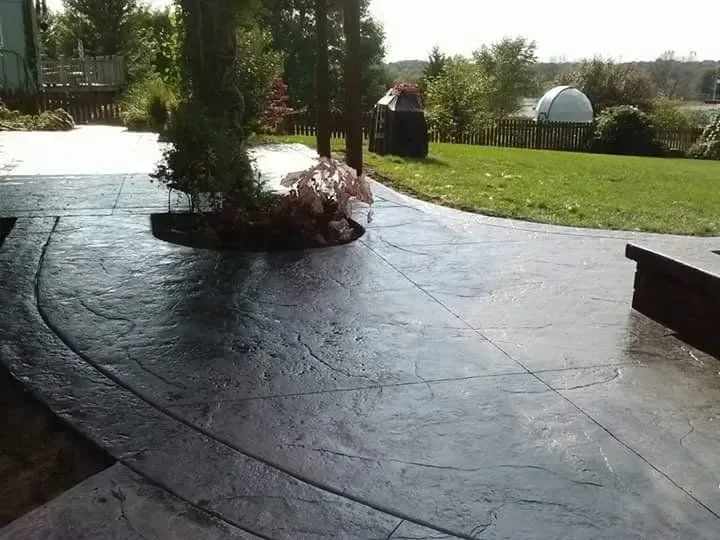
Stamped concrete with air-entrained mix design handles freeze-thaw well. Microscopic air bubbles give expanding ice room to grow without cracking the surface. Combined with a quality acrylic sealer, stamped concrete handles decades of KC winters without structural damage.
Pavers face a different problem. The individual units are dense and frost-resistant. But the sand-filled joints between them are the weak point. Water enters the joints, freezes, expands, and pushes pavers apart. After several winters, you see widening gaps, uneven surfaces, weed infiltration, and ant hills. The sand base beneath the pavers is also vulnerable — frozen groundwater can heave upward and create trip hazards.
Considering a stamped patio or walkway for your KC property?
What About KC's Clay Soil?
The greater Kansas City area sits on heavy clay — particularly in Johnson County, Jackson County, and the southern suburbs. This soil expands when wet and contracts when dry, creating seasonal ground movement that affects every hardscape built on top of it.
Stamped concrete is a rigid slab that bridges over minor soil movement. With a properly compacted base (4–6 inches of aggregate), it distributes load evenly and resists clay heave. Control joints at regular intervals allow the slab to move without visible cracking.
Pavers on clay soil require significantly more base preparation. Even with deeper gravel bases and geotextile fabric, individual pavers shift over time as the clay swells and shrinks. Many homeowners across Overland Park, Olathe, and Lee's Summit have seen paver patios that looked perfect in year one and needed releveling by year three.
Long-Term Maintenance Comparison
Stamped concrete: Reseal every 2–3 years. Pressure wash in spring, apply fresh sealer. A few hours of work protects the surface for another cycle. No weeds to pull, no sand to replace, no shifted pieces to fix.
Pavers: Polymeric sand degrades and needs topping off annually. Weeds and moss grow in joints despite treatment. Individual pavers settle, shift, or crack and need to be pulled and reset. After heavy rain or winter thaw, sections may need releveling. Most KC homeowners spend more time and money maintaining pavers over 10 years than they would have spent on stamped concrete over 20.
When Pavers Actually Make Sense
Pavers aren't a bad product — they have specific situations where they shine. If you need to access underground utilities frequently (sump pump lines, French drains, irrigation), pavers can be pulled up and reset without destroying the surface. They also work well for small accent areas, walkway borders, or decorative insets.
Some homeowners also prefer natural stone pavers for high-end landscape designs where the budget allows premium materials and ongoing maintenance.
When Stamped Concrete Is the Clear Winner
For most residential patios, driveways, pool decks, and walkways in the Kansas City metro, stamped concrete delivers better value. You get the look of premium materials, a surface that handles KC's climate without constant upkeep, and a lower total cost over the life of the project. Installation is faster, maintenance is simpler, and long-term durability on clay soil is superior.
Already have an old patio that needs a refresh? A concrete overlay can transform worn surfaces without full demolition — another advantage pavers can't match. And if you want color without pattern, stained and colored concrete opens up even more design options.
Frequently Asked Questions
Is stamped concrete cheaper than pavers in Kansas City?
Yes. Stamped concrete costs $12–18 per square foot installed in the KC metro, while pavers typically run $15–30 per square foot. The labor savings are significant — stamped concrete is poured and finished in a single day, while pavers require hand-setting each piece over several days.
How long does stamped concrete last in Kansas City?
25–30 years or more with proper installation and maintenance. The key factors are base preparation for KC's clay soil, air-entrained mix design for freeze-thaw resistance, and resealing every 2–3 years.
Do pavers shift on Kansas City's clay soil?
Yes. Clay soil swells when wet and contracts when dry, pushing pavers out of alignment and creating uneven surfaces. This is one of the most common paver complaints in the KC metro.
Can you add a stamped finish to existing concrete?
You can't stamp cured concrete. However, a stampable concrete overlay can be applied over existing slabs to achieve a similar look — a good option if the existing surface is structurally sound.