A new concrete driveway in the Kansas City metro costs $8–18 per square foot installed, depending on the finish type. For a standard 600-square-foot double-car driveway, most homeowners pay between $4,800 and $10,800 — with the exact number determined by the existing conditions, decorative options, and site access.
This guide breaks down the real costs by driveway type, the factors that push your price up or down, what should be in a professional estimate, and how to spot red flags in cheap bids.
Cost by Driveway Type
Here's what you can expect to pay per square foot in the Kansas City metro as of 2026:
| Driveway Type | Cost Per Sq Ft | 600 Sq Ft Estimate |
|---|---|---|
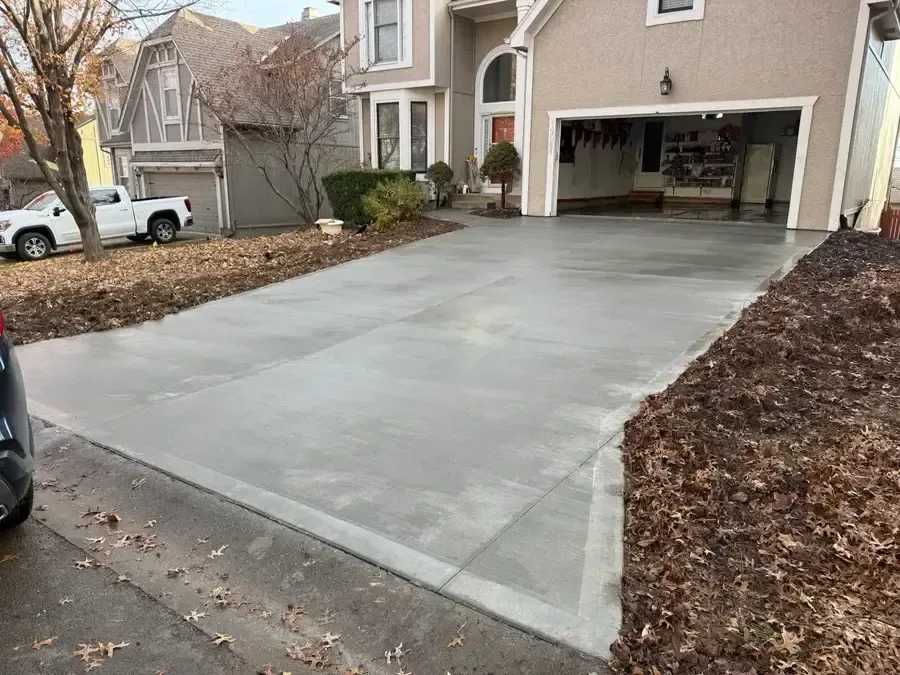
| Standard Gray | $8–12 | $4,800–$7,200 |
| Colored / Stained | $10–15 | $6,000–$9,000 |
| Exposed Aggregate | $10–16 | $6,000–$9,600 |
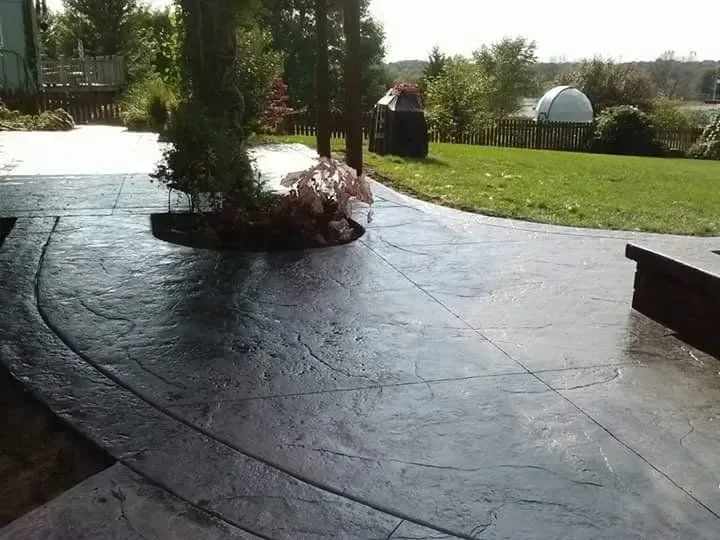
| Stamped / Decorative | $12–18 | $7,200–$10,800 |
These prices include demolition of the old surface, base preparation, the pour, finishing, and standard control joints. Sealer application is sometimes extra — ask your contractor whether it's included.
What Factors Affect the Final Price?
1. Old Driveway Removal
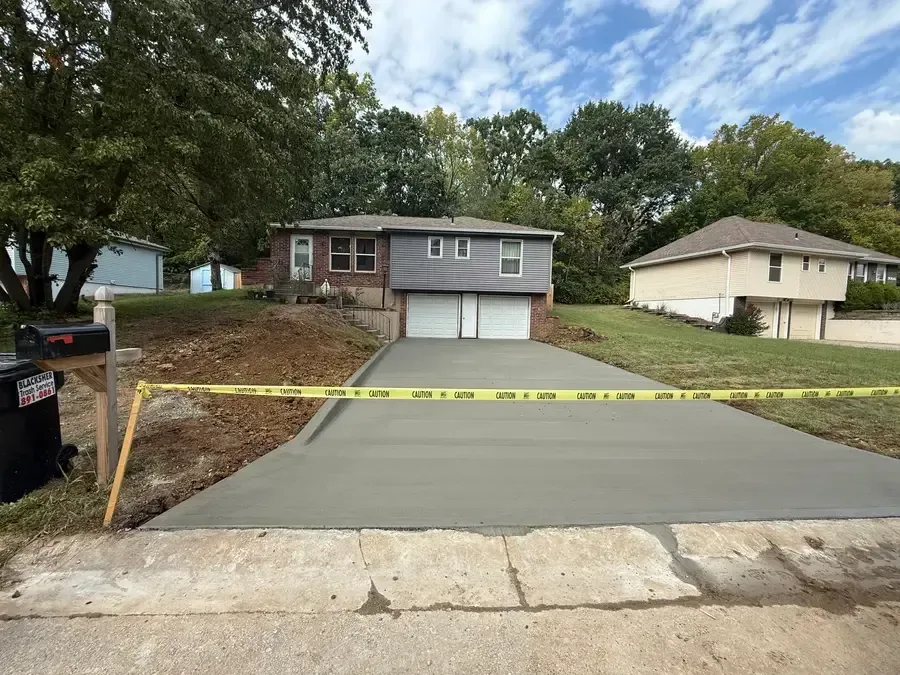
Demolishing and hauling away your existing driveway adds $2–4 per square foot. A 600 sqft removal runs $1,200–$2,400. Thicker slabs (6+ inches) and driveways with rebar reinforcement cost more to break up. If your old driveway is asphalt, removal is cheaper — $1.50–2.50 per sqft.
2. Soil Conditions
Kansas City sits on expansive clay soil that swells when wet and shrinks when dry. If your subgrade isn't stable, the contractor needs to excavate deeper and add more compacted aggregate base — sometimes 6–8 inches instead of the standard 4. This adds $1–3 per square foot. Properties with significant erosion, tree root damage, or poor drainage may need even more prep work.
Want to know exactly what your driveway will cost?
3. Size and Layout
Larger driveways get a lower per-square-foot cost because setup and mobilization costs are spread over more area. A 400 sqft single-car driveway might run $10/sqft, while a 900 sqft double-wide with a turnaround might come in at $8/sqft for the same finish. Irregular shapes, curves, and multiple access points add complexity and cost.
4. Access and Slope
If the concrete truck can't get close to your driveway, the crew needs to pump the concrete — adding $500–1,200 depending on distance. Steep driveways require thicker slabs, additional reinforcement, and more labor for forming and finishing. Hillside properties in areas like Waldo, Brookside, and the Northland often see 15–25% higher costs than flat lots.
5. Decorative Options
Upgrading from standard gray to stamped concrete adds $4–8 per square foot. Color hardener, release agents, and stamping labor are the main cost drivers. Simpler patterns (ashlar slate, running bond) cost less than complex patterns (European fan, random stone). Adding a contrasting border color or multiple stamp patterns adds another $2–4 per sqft to the decorative areas.
What Should Be in a Professional Estimate?
A legitimate concrete estimate should spell out every cost on paper. Here's what to look for:
- Demolition and removal — of existing driveway, including haul-off
- Excavation and base prep — depth of aggregate base, compaction method
- Concrete specs — thickness, PSI strength, air entrainment (critical for KC freeze-thaw)
- Reinforcement — fiber mesh, rebar, or wire mesh
- Finishing — broom finish, exposed aggregate, stamped pattern, coloring
- Control joints — placement and spacing
- Sealer — included or extra, type of sealer
- Timeline — start date, pour date, cure time before you can drive on it
- Cleanup — site cleanup, form removal, debris haul-off
If an estimate is just one number with no line items, ask for a breakdown. A contractor who won't itemize costs is a contractor you shouldn't hire.
We provide detailed, line-item estimates on every project — no mystery pricing.
How to Compare Quotes
Get at least three estimates. When comparing, make sure you're looking at the same scope. A $6,000 estimate that includes 4" thickness, fiber mesh, and sealer is a better deal than a $5,000 estimate with 3.5" thickness, no reinforcement, and sealer as a $600 add-on.
Ask every contractor the same questions: What PSI concrete do you use? Do you air-entrain the mix? How deep is your aggregate base? What reinforcement is included? How many control joints? These details separate a 10-year driveway from a 30-year driveway — and they're where cheap bids cut corners.
Red Flags in Cheap Bids
A bid that's 30–40% below the others isn't a great deal — it's a warning sign. Here's where low-cost contractors typically cut corners:
- Thinner concrete — 3" instead of 4". Saves the contractor $1–2/sqft but cuts the driveway's lifespan in half.
- No air entrainment — The mix costs less without it, but the surface will spall and flake after a few KC winters.
- Skipping base prep — Pouring directly on clay soil saves time but guarantees cracking and settling within 2–3 years.
- No reinforcement — Wire mesh or fiber costs $0.50–1.50/sqft. Skipping it means more cracking, sooner.
- Wrong control joint spacing — Joints too far apart lead to random cracking. The slab decides where to crack, not the contractor.
A driveway poured wrong costs more to fix than it would have cost to pour right. If a bid seems too low, ask what's being left out. A concrete overlay or resurfacing over a failed driveway costs nearly as much as the original pour.
Frequently Asked Questions
How much does a basic concrete driveway cost in Kansas City?
A standard gray concrete driveway costs $8–12 per square foot installed. For a typical 600 sqft double-car driveway, that's $4,800–$7,200 including demolition, base prep, pouring, finishing, and control joints.
How much more does stamped concrete cost?
Stamped concrete driveways run $12–18 per square foot — roughly 50–80% more than standard gray. For a 600 sqft driveway, expect $7,200–$10,800.
Does removing the old driveway add to the cost?
Yes. Demolition and removal adds $2–4 per square foot. For a 600 sqft driveway, that's $1,200–$2,400 extra for breaking up the old concrete, hauling it away, and disposal.
How long does a concrete driveway last in Kansas City?
25–30 years with proper installation. The key factors are 4" minimum thickness, proper base compaction, air-entrained mix for freeze-thaw resistance, and well-placed control joints.